舆图
比哈尔谢里夫 城镇
Bihār Sharīf · 比哈尔邦
- 国家 / 地区
- 印度
- 一级行政区
- 比哈尔邦
- 坐标
- 北纬 25.20°,东经 85.52°

示意图,边界据 Natural Earth,不作为划界依据。
更多资料
- 海拔(Wikidata)
- 60 米
- 所属行政区
- 那兰达县
- 邮政编码
- 803101
- 电话区号
- 6112
百科(英文)
这个词条没有中文维基百科条目,下面是英文维基百科的原文。
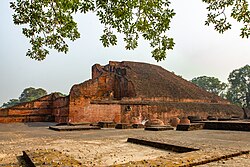
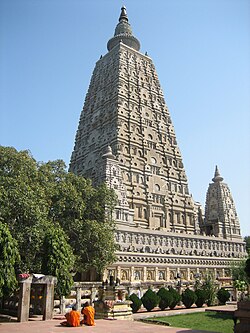
Bihar Sharif is the headquarters of Nalanda district and the fifth-largest sub-metropolitan area in the eastern Indian state of Bihar. Its name is a combination of two words: Bihar, derived from vihara (meaning monastery), also the name of the state; and Sharif (meaning noble). The city is a hub of education and trade in southern Bihar, and the economy centers around agriculture supplemented by tourism, the education sector and household manufacturing. The ruins of the ancient Nalanda Mahavihara, a UNESCO World Heritage Site, are located near the city.
Under the Pala Empire, Odantapuri, a major Buddhist monastic university was built at the site of Bihar Sharif. In the early 14th century, the city was captured by the Delhi Sultanate. Bihar Sharif was later ruled by other Muslim dynasties and then by the British until Indian independence in 1947. The city has important Buddhist, Hindu and Muslim heritage sites and landmarks.
Bihar Sharif is one of the one hundred Indian cities selected to gain funds under Prime Minister Narendra Modi's flagship Smart Cities Mission. Bihar Sharif was selected in the preliminary list of 100 cities in July 2015 that were to compete for the Smart Cities project.
According to Ease of Living Index 2020, Bihar Sharif has been ranked as the most livable among cities in Bihar which have population under 1 million. It was ranked 1st in Bihar and 28th among cities with a population under 1 million in India with an overall ranking of 63rd among 111 Indian cities.
Etymology
The city's name is a combination of two words: Bihar, derived from vihara (meaning monastery), also the name of the state; and Sharif (meaning noble), referring to the resting place of the Sufi Saint Sheikh Makhdoom Sharfuddin Ahmed Yahya Maneri.
History
Classical and medieval period
A pillar dating to the 5th century from the time of the Gupta Empire was found near the fort of Bihar Sharif. It is 14 ft tall and has two inscriptions inscribed upon it by two Gupta rulers, first of Kumaragupta (413–455 CE) and second of Skandagupta (456–480 CE).
The name Bihar is derived from vihar or vihara, meaning Buddhist monastery, a reference to the ancient Odantapuri University established near the city in the 7th century CE by Pala king Gopala I. The settlement does, however, predate the Buddha. It became the capital of the Magadha kingdom in the Pala Empire.
Odantapuri is considered to have been the second-oldest of India's Mahaviharas, and it is believed to have been located on or at the foot of Bari Pahari (English: Big Hill), or in the present-day Gadh Par locality of Bihar Sharif. According to Tibetan records it housed about 12,000 students and was an important centre of Buddhist learning. Acharya Sri Ganga of Vikramashila was a student there.
The Big Hill or Badi Pahadi was known as Pashravati at the time.
Geography
Bihar Sharif is located 74 km (46 mi) from Patna, the capital of Bihar state (via NH30 and 20). It is situated at the foot of Bari Pahari (a.k.a. Peer Pahari(Monday Mountain )and on the bank of the Panchanan (Panchane) River. The land around Bihar Sharif is very fertile, with alluvial soil deposited by several rivers. These local rivers include the Mahane, the Panchane – which divides west of Pawapuri into the Goithwa, Soyaba and smaller rivers – the Zerain, and others. To the west is the Paimar River, a tributary of the Ganges.
Demographics
As of the 2011 India census, Bihar Sharif had a population of 297,268, up from 231,972 in 2001 and around 130,000 in 1981. The sex ratio was 916 females per 1000 males, with a slightly higher ratio of 927 females per 1,000 males among children. The overall literacy rate was 75.30%, with male literacy at 80.80% and female literacy at 69.28%.
Religion
According to the 2011 census, 65.86% of the city's population identifies as Hindu, 33.59% identifies as Muslim, 0.34% did not answer the census question, 0.17% identifies as Christian, and fewer than fifty identified with each of the other religious groups on the survey. A 1981 report lists a 48% proportion of Muslims and notes this as unusual for the area.
In 2012, plans were announced for the construction of a local Bahá'í House of Worship in Bihar Sharif. This would be only the second House of Worship for India's nearly two million Bahá'ís (the first being the well-known Lotus Temple in Delhi), and one of the first two local Bahá'í Houses of Worship in Asia (the other being in Battambang, Cambodia).
Administration
The Town Police Station (Bihar Thana) is the first child-friendly police station in the state of Bihar.
Economy
Agricultural trade and Education are the two main economic activities of Bihar Sharif, with crops including cauliflower, potato, mustard seed and other vegetables, which are exported to neighbouring states. The region is well known for extensive production of vegetables.
Tourism to nearby sites like Nalanda, Rajgir and Pawapuri also boosts the city's economy, as do footwear and garments manufactured by household industries. The locality of Sohsarai in the city hosts an extensive textile market, which is known as "Mini Surat".
As of 1981, the city had a major beedi cigarette industry which employed 15,000 people, mainly Muslims and some lower-caste Hindus.
In recent years the city has changed from a trade-based economy to an education hub.
Bihar Sharif is one of four cities selected in Bihar state among the 100 Indian cities to developed as smart cities under Prime Minister Narendra Modi's flagship Smart Cities Mission. It figured in amongst the ambitious 100 smart cities list to receive funding in the fifth round of the smart cities project in January 2018.
Culture and cityscape
Heritage and important sites
The city of Bihar Sharif also has the designation of the location of the first museum in Bihar. The first Bihar Museum, established here in the late 19th century by Alexander Meyrick Broadley was not just the oldest museum in Bihar but also one of the oldest in India. Broadley was the district magistrate of Bihar Sharif in 1860s and one of the earliest surveyors and explorers of Bihar. During the course of his amateur excavations, he collected many sculptures and architectural fragments, with which he established a museum at the Collector's Bungalow at Bihar Sharif in 1871–1872. The collection recorded at least 686 artefacts. In 1891, the governor of Bengal of decided to transfer the contents of the Bihar Museum to Indian Museum in Calcutta. After the foundation of Patna Museum, a significant part of the collection was transferred there, listed in the catalogue as from Broadley Collection.
The Bihar Sharif Pillar Inscriptions from the Gupta Empire were found in front of the northern gate of the fort of Bihar (Bihar Sharif).
Events
Urs or Annual "Chiraga" Fair
Transport
Roadways
The city is connected by road to major cities like Patna, Rajgir, Nalanda, Nawada, Mehsi, Harnaut, Jamshedpur, Ranchi, Dhanbad, Bokaro, Koderma, Kolkata, Gaya, Hazaribag, Barhi, Jehanabad, Bakhtiyarpur, Barh, Mokama, Munger, Purnea and Ramgarh. Being the district headquarters, it is a major transport hub and has regular bus service to all other major destinations in the region.
NH 33 and NH 20, a part of Asian Highway Network and AH42 passes through the city. NH 33 and NH 20 intersects each other in the city. NH 20 connects to Patna via Bakhtiyarpur and to Nawada, Barhi, Koderma, Hazaribagh and Ranchi. NH 33 connects the city to Mokama, Barbigha, Asthawan, Jahanabad and Arwal.
NH 120 starts here and runs to Dumraon via Nalanda, Rajgir and Gaya.
SH 78 connects it with Chandi, Daniyawan and Hilsa.
Public transport
Bihar Sharif is a part of the Intercity bus service of Bihar State Road Transport Corporation and Patna City bus service. So, state-owned Intercity bus services to the State capital Patna is available at very short intervals.
Education
A number of colleges, schools and educational institutions are located in the city. Notable institutions include:
Universities
K. K. University
Colleges
Nalanda College, second oldest college of Bihar.
Sardar Patel Memorial College
Nalanda Mahila College
Kisan College, Nalanda
Media and entertainment
Hindi dailies such as Dainik Jagran, Hindustan, Dainik Bhaskar, Prabhat Khabar, Aj and other local dailies are available as well as English-language newspapers including Times of India, The Hindu along with various types of magazines.
Keshav Ram Bhatta, a Maharashtrian Brahman that settled in Bihar Sharif published Bihar Bandhu, the first Hindi newspaper from Bihar in 1872.
In popular culture
Director Prakash Jha's National Award-winning documentary film Faces after Storms (1981) was based on the incident of communal riots that took place in Bihar Sharif in May 1981.
Notable people
Shah Amanat, prominent Sufi figure
Aasim Bihari, social activist
Zafar Iqbal, former Indian field hockey player and captain
Saba Karim, former Indian cricketer
Vikas Kumar, actor
Sharfuddin Yahya Maneri, a Sufi mystic
L. S. N. Prasad, Indian paediatrician and Padma Shri recipient
Vijay Kumar Yadav, former Member of Parliament from Nalanda
以上摘自英文维基百科「Bihar Sharif」(有删节;去掉了表格、图片、参考文献和外部链接),按 CC BY-SA 4.0 使用。全文和最新版本请看原文。