舆图
比南奥南 城镇
Binangonan · 卡拉巴松
- 国家 / 地区
- 菲律宾
- 一级行政区
- 卡拉巴松
- 坐标
- 北纬 14.46°,东经 121.19°

示意图,边界据 Natural Earth,不作为划界依据。
更多资料
- 人口(Wikidata)
- 321,281(2024 年)
- 面积
- 66.3 平方千米
- 海拔(Wikidata)
- 21 米
- 所属行政区
- 黎刹省
- 设立
- 1737 年
- 邮政编码
- 1940
- 电话区号
- 2
- 邻接
- 莫龙村
- 政府首脑
- Cesar Ynares
人口变化
| 年份 | 人口 | 较上一次 | |
|---|---|---|---|
| 1903 | 9,096 | ||
| 1918 | 14,379 | +58.1% | |
| 1939 | 16,588 | +15.4% | |
| 1948 | 20,422 | +23.1% | |
| 1960 | 31,274 | +53.1% | |
| 1970 | 52,296 | +67.2% | |
| 1975 | 63,215 | +20.9% | |
| 1980 | 80,980 | +28.1% | |
| 1990 | 127,561 | +57.5% | |
| 1995 | 140,700 | +10.3% | |
| 2000 | 187,691 | +33.4% | |
| 2007 | 238,931 | +27.3% | |
| 2010 | 249,872 | +4.6% | |
| 2015 | 282,474 | +13.0% | |
| 2020 | 313,631 | +11.0% | |
| 2024 | 321,281 | +2.4% |
Wikidata 记录的历次人口数(普查和估计混在一起,口径可能不同)。
百科(英文)
这个词条没有中文维基百科条目,下面是英文维基百科的原文。
Binangonan, officially the Municipality of Binangonan (Tagalog: Bayan ng Binangonan), is a municipality in the province of Rizal, Philippines. According to the 2024 census, it has a population of 321,281 people.
A thriving fish port and fishing industry is found in Binangonan, having a long coast line facing Laguna de Bay, including the western part of Talim Island. The plant of Rizal Cement and Grandspan are in Binangonan as well.
Etymology
At the height of the Philippine Revolution against the Spanish government, the townspeople of Binangonan rose in revolt in defiance of the Spanish authorities, as they joined the revolutionary group called Katipunan. The town's uprising was disparaged by the colonial authorities as "Binangonan de los Perros" (trans.: "of the dogs") but the ridicule did not prosper. The etymology of Binangonan (Tagalog: bangon, meaning "to rise"") is traced to this origin, where events or people had arisen.
History
The Neolithic stone engravings of the Angono Petroglyphs archaeological site represent the earliest evidence of human settlement in the region. The site contains earthenware fragments and remains of animals such as turtles and Elephas sp. The area was inhabited by both Tagalog and Aeta peoples before the arrival of the Spanish.
Spanish colonial era
Binangonan was initially a visita of the pueblo (town) of Moron, until it was separated and became an independent parish in 1621 through the initiatives of Franciscan missionaries. The town was established in 1737 and conquered by the Spaniards in 1763. Originally, it was organized under the province of La Laguna, until it was transferred to the newly established Distrito de Morong on February 23, 1853. The Santa Ursula Parish Church dates from this time, built from 1792 to 1800.
American colonial era
Binangonan became a town in 1900 during the American colonial period. On June 11, 1901, it was incorporated into the newly established province of Rizal, after being part of the District of Morong. In the same year, Don Jose Ynares y Granados was appointed Presidente or municipal executive. He won the first municipal election held in 1902. With help from the Americans, Ynares made remarkable improvements in the town.
On October 12, 1903, by virtue of Act No. 942, it was annexed to the town Morong alongside Baras and Cardona. However, the act was amended by virtue of Act No. 984 on November 6, 1903, wherein Binangonan regained its independent status by separating from Morong and gaining Angono from Taytay.
Japanese occupation
During World War II, Binangonan was one of the evacuation centers for the residents of Manila and neighboring suburbs. People hid in the mountains and in Talim Island.
Geography
Binangonan is bounded to the north-northwest by Angono, the north-northeast by Teresa and Morong, and to the east by Cardona. It is divided between two regions, the mainland and the insular areas. The mainland is on the western side of the Morong Peninsula, and is characterized by small steep hills surrounded by lowlands. It is cut off by an escarpment to the east, which forms the boundary with Cardona. Short streams predominantly drain westward into Laguna de Bay.
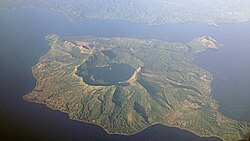
Talim Island contains a narrow coastal plain that readily ascends into its mountainous interior, with Mount Tagapo (438 m) as its highest peak. It is separated from the mainland by the 240-m Diablo pass.
Binangonan is 17 kilometres (11 mi) from Antipolo and 34 kilometres (21 mi) from Manila.
With the continuous expansion of Metro Manila, Binangonan is now part of Manila's built-up area which reaches Cardona in its easternmost part.
Climate
Binangonan features two climate types under the Köppen-Geiger climate classification: tropical monsoon with a short dry season and a prolonged wet season, and tropical savanna with more pronounced wet and dry season. The dry season runs from January through April while the wet season covers the remaining eight months of the year. Binangonan is consistently hot throughout the year, usually reaching its highest temperatures just before the onset of the monsoon. The town's coolest temperatures are typically experienced at night during the earliest portions of the dry season. Temperatures are relatively constant throughout the year with the average high of about 31 °C (88 °F) and an average low of about 23 °C (73 °F).
Demographics
In the 2024 census, the population of Binangonan was 321,281 people, with a density of 4,800 inhabitants per square kilometre or 12,000 inhabitants per square mile.
Economy
Binangonan's major source of income comes from agriculture, where 49 percent of its total land area are devoted to agriculture and livestock industries, while the source of income of residents in its coastal barangays are mainly artisanal fishing and the aquaculture industry. Binangonan is a major supplier of freshwater fishes from Laguna de Bay like dulong, ayungin, biya, kanduli, and gurami to Metro Manila, Laguna, Cavite and Batangas. A research station of the Southeast Asian Fisheries Development Center is located at Tapao Point in Barangay Pipindan.
The municipality formerly hosted the Rizal Cement plant in Calumpang and its associated quarry. This plant was the oldest in the Philippines, established in 1914 by Augustinians and eventually acquired by Vicente Madrigal. A limestone quarry in Pantok supplied the plant through a cable car system. The plant was shut down in 2000 and subsequently transformed into a subdivision.
Other sources of income come from manufacturing, commercial establishments, real estate, and public utility services.
Binangonan's economy remained docile for almost four decades, subsisting only with fair performance in the aquaculture and agricultural ventures with no new developments in-place to create job opportunities in the commercial sector. Tourism industry's growth remains to be seen in the long-term. Industries relative interests to the town has to be developed and the corresponding infrastructure must be funded and implemented accordingly to create and sustain future development.
Tourism
Tourist Attractions
Angono-Binangonan Petroglyphs
Art Sector Gallery
Binangonan Municipal Library & Museum
Binangonan Recreation and Conference Center
Binangonan Skatepark
Government
Local government
The municipality is governed by a municipal mayor designated as its local chief executive and by a municipal council as its legislative body in accordance with the Local Government Code. The mayor, vice mayor, and the councilors are elected directly by the people through an election which is being held every three years.
Elected officials
List of current government officials from June 30, 2025.
List of former mayors
Source:
List of former vice mayors
Source:
Healthcare
Binangonan Municipal Community Health Center, Libis
Binangonan Lakeview Hospital, Tagpos
Pag-asa Hospital, Pag-asa
Margarito A. Duavit Memorial Hospital – Rizal Provincial Hospital System, Binangonan (Annex)
St. Bernard Infirmary and Multi-Specialty Clinic, Pantok
Barangay Health Centers are present in all 40 barangays
Education
The Department of Education operates 36 elementary and 9 secondary schools in the municipality. A campus of the University of Rizal System is present. A Technical Education Skills Development Authority (TESDA) center established in the municipality provides technical and vocational courses. Over 50 private schools are also found within the municipality,
There are three schools district offices which govern all educational institutions within the municipality. They oversee the management and operations of all private and public, from primary to secondary schools. These are the Binangonan I Schools District, Binangonan II Schools District, and Binangonan III Schools District.
Public
Higher educational institution
University of Rizal System – Binangonan Campus
Secondary schools
Rizal National Science High School
Vicente Madrigal National High School
Guronasyon Foundation Inc. National High School
Don Jose M. Ynares Sr. Memorial National High School
Margarito A. Duavit Memorial National High School
Mahabang Parang National High School
Janosa National High School
Talim National High School
Pag-asa National High School
Primary and elementary schools
DISTRICT I
Binangonan Elementary School
Calumpang Elementary School
Darangan Elementary School
Mahabang Parang Elementary School
Libis Elementary School
Libid Elementary School
Macamot Elementary School
Tatala Elementary School
Casimiro Ynares Elementary School
Pila-Pila Elementary School
DISTRICT II
Lunsad Elementary School
Limbon-Limbon Elementary School
Ithan Elementary School
Kalinawan Elementary School
Pipindan Elementary School
Kasile Elementary School
Bombong Elementary School
Kinagatan Elementary School
Kinaboogan Elementary School
Bangad Elementary School
Notable personalities
Gloc-9, rap artist, musician, songwriter
Joseph Marco, actor and model
Valentin Mechilina, conductor and composer known for his Dalampasigan overture
Jack Duavit, politician and businessman
Consuelo Ynares-Santiago, former associate justice of the Supreme Court of the Philippines
Mia Ynares, politician and businesswoman
Ronnel Arambulo, fisherman and labor leader; 2025 senatorial candidate
以上摘自英文维基百科「Binangonan」(有删节;去掉了表格、图片、参考文献和外部链接),按 CC BY-SA 4.0 使用。全文和最新版本请看原文。