舆图
Midsayap 城镇
索科斯克萨尔根
- 国家 / 地区
- 菲律宾
- 一级行政区
- 索科斯克萨尔根
- 坐标
- 北纬 7.19°,东经 124.53°

示意图,边界据 Natural Earth,不作为划界依据。
更多资料
- 人口(Wikidata)
- 115,735(2024 年)
- 面积
- 290.4 平方千米
- 海拔(Wikidata)
- 29 米
- 所属行政区
- 哥打巴托省
- 设立
- 1936 年
- 邮政编码
- 9410
- 电话区号
- 64
- 邻接
- Libungan
人口变化
| 年份 | 人口 | 较上一次 | |
|---|---|---|---|
| 1939 | 23,033 | ||
| 1948 | 42,473 | +84.4% | |
| 1960 | 46,169 | +8.7% | |
| 1970 | 47,093 | +2.0% | |
| 1975 | 52,142 | +10.7% | |
| 1980 | 66,952 | +28.4% | |
| 1990 | 84,041 | +25.5% | |
| 1995 | 96,771 | +15.1% | |
| 2000 | 105,760 | +9.3% | |
| 2007 | 123,324 | +16.6% | |
| 2010 | 134,170 | +8.8% | |
| 2015 | 151,684 | +13.1% | |
| 2020 | 117,365 | -22.6% | |
| 2024 | 115,735 | -1.4% |
Wikidata 记录的历次人口数(普查和估计混在一起,口径可能不同)。
百科(英文)
这个词条没有中文维基百科条目,下面是英文维基百科的原文。
Midsayap, officially the Municipality of Midsayap (Maguindanaon: Inged nu Midsayap, Jawi: ايڠد نو ميدسايڤ; Iranun: Inged a Midsayap, ايڠد نو ميدسايۏ; Hiligaynon: Banwa sang Midsayap; Cebuano: Lungsod sa Midsayap; Tagalog: Bayan ng Midsayap), is a municipality in the Province of Cotabato, Philippines. According to the 2024 census, it has a population of 115,735 people.
History
Midsayap was derived from a Maguindanaon term which means (Mid) Center and (Sayap) Straw Hat. Midsayap means a straw hat at the center – just like a hill centrally located at the Municipality which slopes through the plains in a shape of a hat. Other version relates that Midsayap came from a Maguindanaon term which means "person wore a straw hat". From 1912 to 1926, Midsayap was then a district of Dulawan and Pikit. Originally, Midsayap was inhabited by Muslims from the descendants of Sultan Ali Bayao from the lineage of Sultan Dipatuan Kudarat I. The seat of their sultanate was established at Libungan Torreta (now part of Pigcawayan).
In 1927, a Philippine Constabulary (PC) Commander assigned in the area, Ist Lt. Catalino Javier, initiated the development of some portions of the municipality. Seeing the natural bounty of the area, he invited settlers from Luzon and Visayas to migrate in the area. The first wave of settlers who dared develop the wilderness was the late Antonio Labasan from Zambales. Among his companions were 23 interrelated families, the Rosete, Almazan, Dumlaos, Flautas, Fernandezes, Quiñoneses, Fermils, Fantones and Documos who settled at Sitio Salunayan and Bual.
Geography
Midsayap is geographically located at the Southwestern portion of Cotabato. It is bounded on the north by the Municipality of Libungan; on the south by the Rio Grande de Mindanao; on the east by the municipalities of Aleosan and Pikit; and on the west by the Municipality of Kabuntalan.
Midsayap is approximately 47 kilometres (29 mi) away from Cotabato City and some 174 kilometres (108 mi) from Davao City, two of the major urban centers in Mindanao. It is about 64 kilometres (40 mi) away from Kidapawan City, the seat of the Provincial Government.
Midsayap has a total land area of 29,042 hectares comprising 57 barangays which is 5.03% of the total land area of Cotabato. Some of the barangays (Southern and Western part) are along the big bodies of water, thus making it accessible by water transportation. However, due to the construction of a concrete bridge at Dulawan towards the province of Sultan Kudarat and some municipalities of Maguindanao del Sur, land transportation is now feasible. The town is traversed by the Davao-Cotabato and the Midsayap-Makar national highways (General Santos).
Demographics
In the 2024 census, the population of Midsayap was 115,735 people, with a density of 400 inhabitants per square kilometre or 1,000 inhabitants per square mile.
The 2010 Census of Population and Housing of the Philippine Statistics Authority recorded the population of Midsayap at 134,170. It is the most populous among the municipalities of the province.
Growing at the pace of 1.92 percent for the past five years, the town is expected to double its population within 36 years.
Midsayap is populated mainly by Maguindanaons and as well as multi-cultural mix of peoples from the influx of migrants from Luzon and the Visayas, drawn to Mindanao's reputation as a promising haven for settlers.
Languages
Cebuano and Tagalog are the widely spoken language. They are also common for people speaking different languages such as Maguindanaon, Iranun, Hiligaynon, Ilocano, Manobo, Waray, among others.
Economy
Poverty incidence of Midsayap (%)
Source: Philippine Statistics Authority
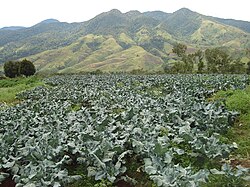
Characterized to have a clay type of soil that is best suited for agricultural use, most (42.03 percent) of the town's land area are devoted to agricultural production. The lowland areas were planted with rice and other seasonal crops while the upland areas were planted with permanent crops. Agricultural products of the town include rice, corn, mango, coffee, coconut, banana, vegetables and root crops.
Aside from the thriving agriculture industry, Midsayap also boasts of its other industries such as cut flowers and ornamental plants, livestock and poultry, furnitures and decorative crafts and telecommunications. It is also a potential area for putting up other industries such as fruit and meat processing as well as oil palm plantation and processing.
Midsayap is a commercial and trading center for the province; farmers from neighboring municipalities bring their agricultural products to be sold or traded there. Industry in the first district of North Cotabato is concentrated in the PPALMA area (Pigcawayan, Pikit, Alamada, Libungan, Midsayap, Aleosan).
Tourism
Annually, the townsfolk of Midsayap prepares for its colorful street dancing and parade competition popularly known as the "Halad sa Santo Niño Festival" as part of its grand fiesta celebration, which is held every third Sunday of January. The Halad Festival is celebrated in honor of the town's patron saint Señor Santo Niño.
Groups from various towns in Cotabato Province as well as neighboring towns of Maguindanao del Norte and Maguindanao del Sur troop annually to Midsayap to participate in the contest, which is recognized by the Department of Tourism as a major festival.
This event started in 1988 through the efforts of REACT Philippines Midsayap Chapter in coordination with the Santo Niño Parish Pastoral Council and became a yearly event.
The festival first gained national recognition when the 1997 Halad champions, Eramis Clan, flew to Manila to compete in the National Finals and bested champions of other major festivals such as the Sinulog Festival of Cebu and the Dinagyang Festival of Iloilo.
Infrastructure
Transportation
Midsayap is served by almost 2,000 tricycles, either traversing through the main highways or within barangays, which are known locally as "tri-sikad".
Transportation to its barangays and adjacent municipalities are also served by Multicabs, Jeepneys, Dagit-Dagit (single motor) and L300 Vans.
The public bus transport system, maintained by the Mindanao Star Bus Company (formerly Weena Express Bus Company), serves the Davao City—Cotabato City Route which passes through the cities of Kidapawan and Digos. In 2021, Rural Transit Mindanao Inc. (RTMI) another bus operator from Vallacar Transit opened its route between Dipolog City - General Santos City that stops at Midsayap as one of its stopovers. Overall, Vallacar Transit or The Yanson Group is the main bus operator in Midsayap serveing routes between Cotabato City, Davao City, Dipolog City, and General Santos City
Public Utility Vans also serve routes to and from the cities of Davao City, Cotabato City, Cagayan de Oro, Tacurong-Isulan, Koronadal and General Santos.
Agencies based in Midsayap
The following are the list of the National Agencies Regional Branch Office in this municipality:
Philippine Rice Research Institute
Education
It is home to two major college campuses, namely Notre Dame of Midsayap College, the first school in Asia of the Notre Dame educational system, and Southern Christian College of the United Church of Christ in the Philippines as well as a host of privately owned tertiary schools offering business, technical, and allied health courses.
It also has an extensive public and private school system (both elementary and secondary) where basic education is delivered in almost all of its barangays.
Furthermore, Midsayap operates day-care centers in all of its 57 barangays for pre-schoolers to begin their early child education.
Tertiary
Cotabato Medical Foundation College Inc.
I-link College of Science and Technology
Midsayap Community College
Notre Dame of Midsayap College
Our Lady of Wisdom Academy
Polytechnic College of Greater Midsayap Cotabato
Southern Christian College
St. Jude College of Science and Technology
Secondary
Public
Dilangalen National High School**
Agriculture High School
Baliki High School
Arizona High School**
Elpidio Singco (Kiwanan) High School
Juan Dillo (Anonang) High School
Kimagango National High School**
Malamote National High School
Malingao High School (Salunayan Annex)
Nabalawag High School
Elementary
Public
Media
FM Radio Stations
94.3 Power Radio (Hypersonic Broadcasting Center)
95.1 Muews Radio (Sagay Broadcasting Corporation)
96.5 DABIG C Radio (Prime Broadcasting Network)
97.3 T Radio Pigcawayan (ELT ADZ and Communication Services)
100.5 Radyo Bandera (Bandera News Philippines/Fairwaves Broadcasting Network)
103.3 Max FM (Rizal Memorial Colleges Broadcasting Corporation)
104.1 Wow FM (Polytechnic Foundation of Cotabato and Asia)
106.1 Brigada News FM (Brigada Mass Media Corporation)
Cable and Satellite TV
JVL Star Cable
Midsayap Cable and Telecommunication Services, Inc.
Cignal TV
以上摘自英文维基百科「Midsayap」(有删节;去掉了表格、图片、参考文献和外部链接),按 CC BY-SA 4.0 使用。全文和最新版本请看原文。