舆图

示意图,边界据 Natural Earth,不作为划界依据。
更多资料
- 人口(Wikidata)
- 174,777(2024 年)
- 面积
- 37.2 平方千米
- 海拔(Wikidata)
- 18 米
- 所属行政区
- 邦阿西楠省
- 设立
- 1590 年
- 邮政编码
- 2400
- 电话区号
- 75
- 邻接
- Calasiao
- 友好城市
- 瓜达拉哈拉、磐田市
人口变化
| 年份 | 人口 | 较上一次 | |
|---|---|---|---|
| 1903 | 20,357 | ||
| 1918 | 22,441 | +10.2% | |
| 1939 | 32,602 | +45.3% | |
| 1948 | 43,838 | +34.5% | |
| 1960 | 63,191 | +44.1% | |
| 1970 | 83,582 | +32.3% | |
| 1975 | 90,092 | +7.8% | |
| 1980 | 98,344 | +9.2% | |
| 1990 | 122,247 | +24.3% | |
| 1995 | 126,214 | +3.2% | |
| 2000 | 130,328 | +3.3% | |
| 2007 | 149,554 | +14.8% | |
| 2010 | 163,676 | +9.4% | |
| 2015 | 171,271 | +4.6% | |
| 2020 | 174,302 | +1.8% | |
| 2024 | 174,777 | +0.3% |
Wikidata 记录的历次人口数(普查和估计混在一起,口径可能不同)。
百科(英文)
这个词条没有中文维基百科条目,下面是英文维基百科的原文。
Dagupan [dɐˈgupan], officially the City of Dagupan (Pangasinan: Siyudad na Dagupan, Ilocano: Siudad ti Dagupan, Filipino: Lungsod ng Dagupan), is an independent component city in the Ilocos Region of the Philippines. According to the 2024 census, it has a population of 174,777 people.
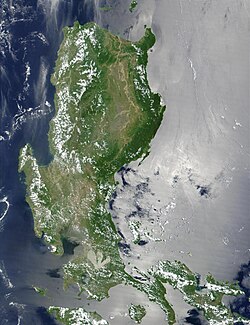
Located on Lingayen Gulf on the northwest-central part of Luzon, Dagupan is the primary commercial and financial center of Pangasinan. The city is also one of the centers of modern medical services, education, media and communication in North-Central Luzon. The NEDA-Regional Development Council officially recognized Dagupan as a regional center. The city is situated within the fertile Agno River Valley and is in turn a part of the larger Central Luzon plain.
The city is among the top producers of milkfish (locally known as bangus) in the province and also the bangus capital of the country. From 2001 to 2003, Dagupan's milkfish production totaled to 35,560.1 metric tons (34,998.5 long tons; 39,198.3 short tons), contributing 16.8 percent to the total provincial production. Of its total production in the past three years, 78.5 percent grew in fish pens/cages, while the rest grew in brackish water fishponds.
Dagupan is administratively and politically independent from the provincial government of Pangasinan and is only represented by the province's legislative district. It is the second most-populous city in the province and in the Ilocos Region, after San Carlos. It is the only independent city of Ilocos Region.
Dagupan is one of the proposed metropolitan areas in the Philippines. Metro Dagupan is proposed to include the independent component city of Dagupan, as well as the towns of Binmaley, Calasiao, Lingayen, Manaoag, Mangaldan, Mapandan, San Fabian, San Jacinto, and Santa Barbara.
Etymology
The city's name was derived from the local Pangasinan word pandaragupan which means gathering place as the city has been a regional market center for centuries; the root word is dagop, Pangasinan term of gather.
History
Pangasinan
Prior to the arrival of the Spanish in the 16th century, the polity of Pangasinan was an ancient coastal region composed of various settlements, whose paramount leaders sent emissaries to China in 1406–1411.
Spanish Period
The area of what is now known as Dagupan was described as a marshland thickly covered with mangrove and nipa palm trees. The natives lived along the shoreline and riverbanks of Calmay, Pantal, and Bonuan; but there were also communities in Malued, Lasip, Pogo, and Bacayao. The natives called the area Bacnotan which would later be incorporated into the encomienda of Lingayen that was established in 1583.
Geography
Dagupan covers a total land area of 4,447.10 hectares (10,989.0 acres), bounded by Lingayen Gulf in the north, San Fabian in the northeast, Mangaldan in the east, Calasiao in the south and Binmaley in the west. Land use is primarily for agriculture with 35.98% of the total land area, fishpond, cropland, residential with 22.88%; others uses are commercial, industrial, institutional, government private, parks and roads.
Dagupan is 14 kilometers (8.7 mi) from Lingayen, the capital of Pangasinan, and 220 kilometers (140 mi) from Manila.
Baranggay and District
Dagupan is politically subdivided into 31 districts. Each district consists of puroks and some have sitios.
Demographics
In Dagupan, the Pangasinans are the predominant people and a minority of residents are dominantly Ilocanos.
Number of Registered Voters (2025): 144,481
Economy
Poverty incidence of Dagupan (%)
Source: Philippine Statistics Authority
Dagupan is the economic center of Pangasinan. As a major regional hub, many people in Pangasinan and nearby provinces commute to the city during the day; this causes the city's daytime population to rise and cause traffic in parts of the city, especially the downtown area. The city is a vital financial center housing numerous banks, non-bank financial institutions, headquarters of corporations and offices of major government departments and agencies.
Historically, Dagupan was a center for salt making in numerous salt evaporator beds in the low-lying swampy areas close to Lingayen Gulf.
Tourism
Dagupan is a historic city that boasts numerous historical, cultural heritage, recreational, ecotourism, business, and culinary tourism of national importance.
Being at the center of trade in the north for centuries blessed with a geography crisscrossed by several rivers and sandy beaches, Dagupan has naturally become a multifaceted city in terms of tourism. Also, as the transportation hub of Pangasinan, the city is easily accessible to the public, whether coming from within or outside of the province.
Food Tourism
Aside from being the Bangus Capital of the Philippines, the city is also known as the Kitchen of the North.
Government
Dagupan, belonging to the fourth congressional district of the province of Pangasinan, is governed by a mayor designated as its local chief executive and by a municipal council as its legislative body in accordance with the Local Government Code. The mayor, vice mayor, and the councilors are elected directly by the people through an election which is being held every three years.
Transportation
Road and railway systems
Dagupan is connected with other cities by networks of national roads. Romulo Highway and Pangasinan–La Union Road (N55) and Urdaneta-Dagupan Road (N57) are the principal highways that serve the city.
The Philippine National Railways (PNR) once served Dagupan through Dagupan station, that went defunct in the late 1980s. The first railroad in the Philippines, the Manila-Dagupan Railway, terminated at the city.
Bus
Intercity/interprovincial buses from Manila serve the city, and are usually operated by Dagupan Bus Company, Victory Liner, Five Star, and Pangasinan Solid North. Jeepneys provide intracity travel, as well as for towns and cities of close proximities.
Healthcare
Medical and health service centers abound in Dagupan. Out of 51 hospitals in Pangasinan, 12 are located in the city. The largest of these is the Region 1 Medical Center with hospital bed capacity of 1000. Other notable hospitals are Dagupan Doctors Villaflor Memorial Hospital, Nazareth General Hospital, and The Medical City Pangasinan.
Education
Since the colonial era, Dagupan has always been the center of education in Ilocos Region (Region 1). The private sector-driven centers of education University of Pangasinan, Universidad de Dagupan, University of Luzon and Lyceum-Northwestern University lead 14 colleges and 18 vocational schools and 3 technical learning centers, 19 secondary schools and 53 elementary schools both in public and private.
The Dagupan City Schools Division Office governs all educational institutions within the municipality. It oversees the management and operations of all private and public, from primary to secondary schools.
Public Malls and Markets
CSI Mall Dagupan
CSI Warehouse Club
CSI Main
CSI Market Square
CSI Bonuan
SM Center Dagupan
Nepo Mall Dagupan
CityMall Mayombo
BHF Plaza Mayombo
MAGIC Centerpoint
MAGIC Club
New Star Mall
Dagupan Malimgas Market
McAdore Market
Magsaysay Fish Market
Fora Mall Dagupan (U/C)
SM City Dagupan (Planned)
Media
Metro Dagupan is home to regional broadcasting stations and television networks. Nineteen radio broadcasting Stations (9 AM and 10 FM), at least seventeen local newspapers and three cable television companies operate in the city. Daily flagship regional news over free TV is served by One North Central Luzon (formerly Balitang Amianan) via GMA Dagupan Station.
TV stations
ALLTV Pangasinan (analog: Channel 3 and digital: Channel 30)
IBC Pangasinan (analog: Channel 6 and digital: Channel 17)
PTV Cordillera (analog: Channel 8 and digital: Channel 42)
GMA Dagupan (analog: Channel 10 and digital: Channel 38)
RPTV Pangasinan (analog: Channel 12 and digital: Channel 19)
Cable and satellite TV
Sky Cable Dagupan
USATV
Cignal TV
Notable Personalities
Marion Magat - Professional Basketball Player
Jose Esteves - American Politician, former mayor of Milpitas, California
Jose de Venecia Jr. - Former Speaker of the House of Representatives of the Philippines
Cheryl Cosim - News Anchor
Julius Babao - News Anchor
Antonio Aquitania - Filipino actor
Roi Fabito - Filipino-American YouTuber known by Guava Juice
Maybelyn dela Cruz - Actress and former City Councilor of Dagupan
Sister cities
Guadalajara, Jalisco, Mexico
Iwata, Shizuoka, Japan
Milpitas, California, United States
Tangier, Tanger-Tetouan-Al Hoceima, Morocco
Cabanatuan, Philippines
San Juan, Philippines
以上摘自英文维基百科「Dagupan」(有删节;去掉了表格、图片、参考文献和外部链接),按 CC BY-SA 4.0 使用。全文和最新版本请看原文。