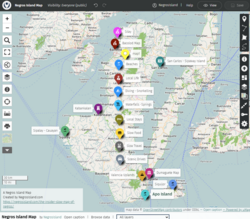
舆图

示意图,边界据 Natural Earth,不作为划界依据。
更多资料
- 人口(Wikidata)
- 161,558(2024 年)
- 面积
- 524.6 平方千米
- 海拔(Wikidata)
- 115 米
- 所属行政区
- 西内格罗省
- 设立
- 1861 年
- 邮政编码
- 6121
- 电话区号
- 34
- 邻接
- 锡莱市
人口变化
| 年份 | 人口 | 较上一次 | |
|---|---|---|---|
| 1903 | 16,429 | ||
| 1918 | 22,183 | +35.0% | |
| 1939 | 41,905 | +88.9% | |
| 1948 | 48,960 | +16.8% | |
| 1960 | 88,542 | +80.8% | |
| 1970 | 124,108 | +40.2% | |
| 1975 | 127,653 | +2.9% | |
| 1980 | 129,632 | +1.6% | |
| 1990 | 119,772 | -7.6% | |
| 1995 | 125,943 | +5.2% | |
| 2000 | 141,954 | +12.7% | |
| 2007 | 150,750 | +6.2% | |
| 2010 | 151,500 | +0.5% | |
| 2015 | 154,723 | +2.1% | |
| 2020 | 158,544 | +2.5% | |
| 2024 | 161,558 | +1.9% |
Wikidata 记录的历次人口数(普查和估计混在一起,口径可能不同)。
百科(英文)
这个词条没有中文维基百科条目,下面是英文维基百科的原文。
Cadiz, officially the City of Cadiz (Hiligaynon: Dakbanwa/Syudad sang Cadiz; Cebuano: Dakbayan sa Cadiz; Filipino: Lungsod ng Cadiz), is a component city in the province of Negros Occidental, Philippines. It was the capital of the short-lived province of Negros del Norte, before the creation of the province was declared unconstitutional on August 18, 1986.
According to the 2024 census, it has a population of 161,558 people.
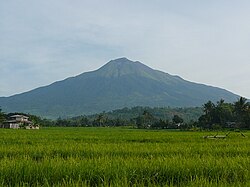
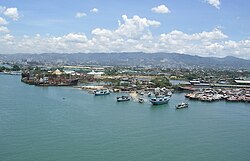
Cadiz has promoted itself as the "Gateway and Premier Center of Agro-Fishery Resources of Negros Occidental," citing its coastal location, agricultural land, and marine resources. A commercial port serving the city was completed and inaugurated in 2010.
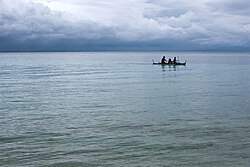
The city is a major sugarcane-producing area. This is transported to Victorias City for further refining. Another major source of livelihood is the harvest of seafood.
The Dinagsa Festival, a celebration which earned Cadiz the name of the Dinagsa Country of the north, is held annually on the last week of January. Some three kilometers off the coast of Barangay Cadiz Viejo is a white sand island resort of Lakawon, a popular destination among the local population.
History
Cadiz traces its beginnings to the establishment of a traditional settlement in a place known as Cadiz Viejo, near the banks of the Hitalon River. Historical records showed that in 1861, the Spaniards came and named the settlement Cadiz because of its northern location which reminded them of the seaport by the same name in Spain.
Cadiz became a municipality independent from Saravia (now E.B. Magalona) in 1878. Its first appointed Gobernadorcillo was Antonio Cabahug, married to Capitana Francisca Cito. During the outbreak of the Philippine Revolution saw Cadiz take part in the insurrection in 1898. As her sons and daughters, headed by Francisco Abelarde, took up arms against their Spanish masters.
During the short-lived government of the cantonal state of the Federal Republica de Negros, Jose Lopez Vito was elected its president. At the onset of American rule, Cadiz was on its way to prosperity with the operation of two lumber companies in the area. The war years stopped these economic activities and brought much suffering to the people of Cadiz. The resistance movement and the local forces of the Philippine Commonwealth Army units put up the civil government in the mountains to deal with civilian affairs. In the post-war election of 1952, Joaquin Ledesma was elected mayor.
Cityhood
In July 1967, Cadiz was inaugurated as a city by virtue of Republic Act No. 4894 which was passed by Congress on June 17, 1967.
Geography
Cadiz is located at the northern part of Negros Occidental, 63 kilometres (39 mi) away from the provincial capital of Bacolod. The city is bounded to the north by the Visayan Sea, to the south by Silay City and Victorias City, to the east by Sagay City and to the west by the municipality of Manapla. It is located within the geographical coordinates of 10 degrees and 50 mins. Latitude NE and 125 degrees and 9 mins. longitude E.
The total land area by land use is 52,457 hectares. An area of 7,354.59 hectares is classified as urban land, which includes residential, commercial, industrial and institutional. 45,102.45 hectares are rural.
The city has reclaimed an area of 38 hectares, 500 meters southeast of City Hall. This area is found alongside of Hitalon River and is ideal for industrial activities.
Barangays
Cadiz is politically subdivided into 22 barangays. Each barangay consists of puroks and some have sitios.
Demographics
Language
Hiligaynon is the major language of the city, with differences in tone and accent from the Hiligaynon used in Metro Bacolod. It is also mixed with a few Cebuano and Spanish words. Tagalog and English are widely taught but seldom used, however, both are frequently used in the academe and businesses.
Economy
Poverty incidence of Cadiz (%)
Source: Philippine Statistics Authority
The total annual income of the city for the year under review is P429,389,619. It is derived from the actual collections of local revenues and Internal Revenue Allotment (IRA).
The city has a total number of 4,965 business establishments, in which 4,750 of which are classified as commercial and 215 as industrial. It has 11 pawnshops, 16 lending corporation and five banking institutions which provide financial capital to businessmen.
The principal sources of livelihood are agriculture and fishing, with employment and business as a secondary source of income.
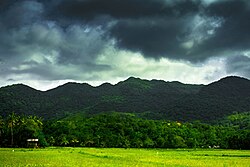
Cadiz has a total agricultural area of 36,475.7429 hectares. Sugarcane remains as the prime agricultural commodity with as large as 23,571.1445 hectares or 64.5242% of the total agricultural area.
Fish supply is more than what the city currently needs. Being rich in natural resources and considered as one of the few fishing centers of Negros Occidental, Cadiz, rich in marine resources, is envisioned to be the seafood center of Negros and an alternative tourist destination. In Barangays Daga and Tiglawigan, for instance, dried fish processing and boat building are the major economic activities.
A P37 million multi-purpose seaport, still under construction, is envisioned to encourage both fishing and commercial vessels to dock in and use the area for trade and industry.
Government
Elected officials
Member of the Cadiz City Council (2025–2028):
Infrastructure
Protective services
As of 2007, the city has 54 policemen serving its 150,750 citizens. The existing policemen-population ratio is 1:2,792 - above the standard ratio of 1:1,000. This necessitates that the city police force employs 97 more policemen.
The Philippine National Police has one headquarter located at the Villa Cristina Subdivision and 6 community police unit precincts located at Barangay Daga, Barangay Banquerohan, the Public Market, Fara-on Institute, Lacawon Island and Barangay Tiglawigan. There are 3 patrol vehicles and 3 motorcycles being utilized by the police force.
Considering that the police force ratio to the populace is not sufficient, the Civilian Volunteers Organization (CVO) was created to augment the policemen. Today, there are 40 members of CVO serving alongside the policemen of the city.
The city has 62 traffic enforcers helping policemen direct and control the traffic flow. The city planned to hire additional traffic enforcers by 2008.
There are three PA Detachments operating in the rural barangays with the main patrol base located at Had. Buenretiro, Barangay Burgos, I PA Special Detachment at Had. Bjormaine, Barangay Magsaysay and I PA Detachment at Had. Ladnon in Barangay Caduha-an.
As of 2007, the Bureau of Jail Management and Penology has 8 personnel and 126 inmates. It is located in Barangay Tinampaan.
The Bureau of Fire Protection, as of 2026, has 3 serviceable fire trucks and 1 Ambulance.
Healthcare
The government health facilities of the city consist of a district hospital with 50 beds, an emergency clinic with 5 beds and 2 extension beds, a city health clinic, 22 Barangay health centers, and 43 school clinics. There are 5 private medical clinics, 3 private family planning clinics, 2 private optical clinics and 3 private clinical laboratories. The government's x-ray clinic and dental clinic further support the health facilities of the city. There are seven drugstores, two of which are open 24 hours a day.
Education
Elementary
High school
College
Cadiz has 76 educational institutions that offer elementary, secondary and tertiary education. 67 are public schools, eight are private, and one is a state-owned university. Out of the 67 public schools, 51 offer elementary education and 16 offer secondary education. Out of eight private schools, four offer elementary education, one offers secondary and elementary, one offers solely secondary, one offers business education and vocational courses, and one offers a computer technology course. The state-owned university offers elementary, secondary and tertiary (BS in Elementary Education, BS in Secondary Education and master's degree in Education) courses.
There are also nine private preparatory schools: Cadiz Evangelical Church Kindergarten School, Northern Negros Private School, Alpha-Omega Christian School, Seventh Day Adventist Elementary School, PNU Early Childhood Education, Kiddie's Joy Kinder School, Solid Ground Christian Academy, Cadiz Christian Learning Center and Creativity School. The seven public preparatory schools are the Cadiz East Elementary Schools 1 and 2, Cadiz West II Elementary School, Villacin Elementary School, Bayabas Elementary School, Don Luis Consing Elementary School and Caduha-an Elementary School.
Notable people
Jose Vasquez Aguilar -Educator, 1st filipino recipient of the Ramon Magsaysay Award (Considered as the Nobel Prize of Asia)
John Becaro - Illustrator and Visual Artist
Rowena Guanzon - Mayor of Cadiz, Commissioner of the Commission on Audit, Commissioner of the Commission on Elections (Philippines)
Christiani Rebada - Singer/Songwriter and Vocal Coach
Amy Lazaro-Javier - Associate Justice of the Supreme Court of the Philippines
以上摘自英文维基百科「Cadiz, Negros Occidental」(有删节;去掉了表格、图片、参考文献和外部链接),按 CC BY-SA 4.0 使用。全文和最新版本请看原文。