舆图
巴哥 城镇
Bago City · 西米沙鄢
- 国家 / 地区
- 菲律宾
- 一级行政区
- 西米沙鄢
- 坐标
- 北纬 10.53°,东经 122.83°

示意图,边界据 Natural Earth,不作为划界依据。
更多资料
- 人口(Wikidata)
- 192,993(2024 年)
- 面积
- 401.2 平方千米
- 海拔(Wikidata)
- 187 米
- 所属行政区
- 西内格罗省
- 邮政编码
- 6101
- 电话区号
- 34
- 邻接
- 巴科洛德
人口变化
| 年份 | 人口 | 较上一次 | |
|---|---|---|---|
| 1903 | 23,630 | ||
| 1918 | 26,262 | +11.1% | |
| 1939 | 53,874 | +105.1% | |
| 1948 | 56,693 | +5.2% | |
| 1960 | 58,834 | +3.8% | |
| 1970 | 71,653 | +21.8% | |
| 1975 | 89,213 | +24.5% | |
| 1980 | 99,631 | +11.7% | |
| 1990 | 122,863 | +23.3% | |
| 1995 | 132,338 | +7.7% | |
| 2000 | 141,721 | +7.1% | |
| 2007 | 159,933 | +12.9% | |
| 2010 | 163,045 | +1.9% | |
| 2015 | 170,981 | +4.9% | |
| 2020 | 191,210 | +11.8% | |
| 2024 | 192,993 | +0.9% |
Wikidata 记录的历次人口数(普查和估计混在一起,口径可能不同)。
百科(英文)
这个词条没有中文维基百科条目,下面是英文维基百科的原文。
Bago, officially the City of Bago (Hiligaynon: Dakbanwa/Syudad sang Bago; Filipino: Lungsod ng Bago), is a component city in the province of Negros Occidental, Philippines. According to the 2024 census, it has a population of 192,993 people.
It is also known as the “Home of Historical and Natural Treasures”, in recognition of its contributions to the history of Negros Occidental and the Philippines, as well as its rich landscapes, flora, and fauna that support its reputation as an ecotourism destination. The city is likewise referred to as the “Boxing Capital of the Philippines” due to the prominence of notable boxers it has produced. It is also home to one of only three known populations of the endangered Irrawaddy dolphin in the entire Philippines, with the other populations found in Guimaras and Palawan. All three are classified as critically endangered.
Etymology
The community was named after a large tree called “bágo” (Gnetum gnemon) under which a native prince Mapagic died according to the writings of a Spanish historian, Diego de Povedano. Another version, however, noted that the name came from the shrub, bago-bago that grew abundantly in the riverbanks.
History
Precolonial Times
Bago was already a barangay mentioned in the epic of Maragtas as a Constituent Barangay of the Kedatuan of Madja-as and it was settled during and after the victory against Chola-occupied Srivijaya, after the sack of Odtojan; where the compromised Rajahs and Sultans who accepted higher positions by corrupt means were carted off to become slaves, Maharlika, and Alipin to serve the Datus of the Philippines along with the native Ati recruits and Malays who accompanied the siege and reconquest as well as evacuation of Odtojan, where the victorious army and navy returned to the Kedatuan with their war booty.
Spanish Era
Its history has its beginning on September 6, 1571, when the Spanish Adelantado, Miguel Lopez de Legaspi, allotted the community to a Spaniard named Juan Gutiérrez de Cortés as his "encomienda". At that time, the community was still composed of small clusters of settlements along the banks of a big river which later became known as the Bago River. The "encomendero", since then, administered to the spiritual and socio-economic needs of the natives in the settlements until June 1578; however, a year before that, this community was placed under the evangelical visitations of Fr. Gerónimo Marín, OSA, an Augustinian priest who had taken charge of the Christianization of the natives of Binalbagan since the year 1572. Father Marín, upon his arrival in the community, celebrated the feast of St. John the Baptist, who would later be accepted as the patron saint of the place. Following the traditions and practices of the Spanish missionaries and historians in recording the founding of a "pueblo" or town that usually coincides with the feast day of a saint and since the feast day of St. John the Baptist, falls on June 24 of each year, it follows thereof that Bago was founded on June 24, 1575. History only records 1575 as the year when Bago was founded so that the exact month and day can only be deduced from such traditional practices of the Spaniards. Manila, Cebu and Binalbagan also predicted the dates of their founding on the same historical situations; hence, the logical conclusion is that Bago was officially founded on the month, day and year heretofore mentioned.
As regards on how the town acquired its name, according to the manuscript of a Spanish historian, Diego López Povedano, which is available in the library of the University of San Carlos, Cebu City, the town was named after a large tree called "Bago" under which, a prince by the name of Mapagic died.
Geography
Located 22 kilometres (14 mi) south of the provincial capital Bacolod and 193 kilometres (120 mi) from Dumaguete, Bago comprises 6.63% of the population of the entire Negros Occidental, making it the third most populous city in the province. It sets a land area of 389 square kilometres, which is 5% of the entire Negros Occidental and 10% of the total land area of component cities.
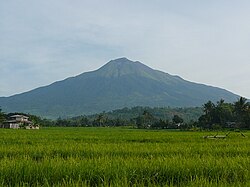
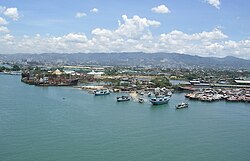
Bago has a total land area of 38,941 hectares, 3,651 ha. of which belongs to Mt. Kanla-on Natural Park. It is composed of 24 barangays, 16 of which are rural and 8 are urban. Based on NSO 2000 census, urban barangays include Abuanan, Atipuluan, Caridad, Balingasag, Don Jorge Araneta, Ma-ao, Poblacion and Taloc. Barangay Ilijan, however, with a distance of 30.50 km from the city proper is the farthest barangay. Barangay Bacong has the biggest land area with 4,827.0350 hectares while Brgy Poblacion, as the smallest, has 311.5044 hectares. The city has 1,100 has-water area and 15 km coastline. Bago is traversed by the widest river in the province, the Bago River, which starts from the northeast slope of Kanlaon Volcano and drains into Guimaras Strait.
It has moderately sloping to rolling lands. Slopes are raging from 0 to 3% comprises 22.911.42 has. 3 to 8% comprises 5,783.92 has. 8 to 18% comprises 4, 682.22 has, 18.1 to 30% comprises 1,514.84 has, 30 to 50% steep hills and rolling comprises 1,735.18 has. and a very steep and mountainous 50% above comprises 2,313.57 has.
Barangays
Bago is politically subdivided into 24 barangays. Each barangay consists of puroks and some have sitios.
Climate
Normally, the city is wet from May to December and dry from January to April with a temperature level of 24.40 degrees Celsius. Average rainfall recorded is 5.68 mm for 89 rainy days within a year while average humidity level is at 76.17%.
Demographics
Languages
99.6% of the residents speak Hiligaynon while 0.4% speak other dialects such as Kinaray-a and Cebuano.
Religion
82% are Roman Catholic, 6% are Aglipayan, 3% are Iglesia ni Cristo, 2% are Convention of Philippine Baptist Churches, and the remaining are either Jehovah's Witnesses, Church of Jesus Christ of Latter-day Saints, Seventh Day Adventists, Evangelicals, etc.
Here are some notes regarding the city's demographic information:
Male Population is 72,777 (NSO 2000 census)
Female Population is 86,944
Urban Population is 60,557 (NSO census)
Rural Population is 81,164 (NSO census)
Barangay Ma-ao has the biggest population of 14,916
Barangay Bagroy has the lowest population of 1,305
Economy
Poverty incidence of Bago (%)
Source: Philippine Statistics Authority
Government
The current Mayor is Marina Javellana-Yao with Andrew Torres serving as Vice Mayor
List of former chief executives
The following were the succeeding municipal presidents and mayors of Bago until the outbreak of the Second World War on December 7, 1941:
The leadership since World War II:
Notable personalities
Athletes
Manuel Araneta Jr. - Member Philippines men’s national basketball team for the 1948 Summer Olympics
Leopoldo Cantancio - Competitor in Boxing for the Philippines for the 1984 Summer Olympics and 1988 Summer Olympics, Silver Medalist for Boxing 1986 Asian Games
Rogen Ladon – Boxer, Asian Games Silver Medalist, Two Time Sea Games Gold Medalist
Aston Palicte - Professional boxer
Eduard Sacapaño - Football Player, Goalkeeper Philippine national football team
Larry Semillano - Competitor in Boxing for the Philippines at the 2000 Summer Olympics
Raul Soyud - Professional basketball player
Mansueto Velasco, Jr. - Silver Medalist for Boxing at the 1996 Summer Olympics. He and his brother Roel are the 1st and only set of siblings to win Olympic medals for the Philippines
Roel Velasco - Bronze Medalist for Boxing at the 1992 Summer Olympics ,1st Olympic Medalist from the Visayas
Isidro Vicera - Competed at the 1992 Summer Olympics for the men’s boxing flyweight event
Arthur Villanueva - World Boxing Council Super Flyweight champion, International Boxing Federation Super Flyweight champion, World Boxing Organization Super Flyweight champion
Business Tycoons
J. Amado Araneta - Business tycoon, owner and developer of Araneta Coliseum and present day Araneta City.
Jorge L. Araneta - Chairman and CEO of The Araneta Group, ranked as the 47th richest person in the Philippines by Forbes Magazine on 2021 with a net worth of $215 million
Roberto Benedicto -Philippine Ambassador to Japan, Chairman of the Philippine National Bank, Business Tycoon. In 1983 it was estimated that he had a net worth of $800 million or $2.5 billion equivalent amount in 2025
Entertainers
Migo Adecer - Actor in television
Chuckie Dreyfuss - Actor in film and television
Vangie Labalan - Film and television actress
Bamboo Mañalac - Musician, singer, songwriter
Government and Political Figures
Liza Araneta Marcos - First Lady of the Philippines as the wife of Bongbong Marcos the 17th President of the Philippines
Esteban de la Rama - Senator of the Philippines, Founder Panay Electric Company, Owner De La Rama Steamship Company, Inc.
Sandro Marcos - Congressman, 35th Majority Floor Leader of the House of Representatives of the Philippines
Ruperto Montinola - 4th and 8th Governor of Iloilo, Senator of the Philippines
Sergio Osmeña III - Senator of the Philippines
Tomas Osmeña - 24th Mayor of Cebu City, Member of the Philippine House of Representatives
Heroes and Historical Figures
Juan Araneta - Revolutionary, National Hero, 1st Secretary of War of the Republic of Negros
以上摘自英文维基百科「Bago, Negros Occidental」(有删节;去掉了表格、图片、参考文献和外部链接),按 CC BY-SA 4.0 使用。全文和最新版本请看原文。