舆图

资料
百科(英文)
这个词条没有中文维基百科条目,下面是英文维基百科的原文。
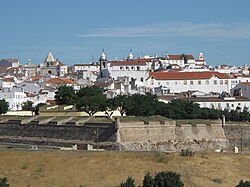
Old Town of Cáceres is a historic walled city in Cáceres, Spain.
Cáceres was declared a World Heritage City by UNESCO in 1986 because of the city's blend of Roman, Moorish, Northern Gothic and Italian Renaissance architecture. Thirty towers from the Islamic period still stand in Cáceres, of which the Torre del Bujaco is the most famous.
There have been settlements near Cáceres since prehistoric times. Evidence of this can be found in the caves of Maltravieso and El Conejar. The city was founded by the Romans in 25 BC.
The Old Town (Parte Antigua) still has its ancient walls; this part of town is also well known for its multitude of storks' nests.
History
The origins of Cáceres were in prehistoric times, as evidenced by the paintings in the Cuevas de Maltravieso (Maltravieso Caves) which date back to the late Paleolithic period. Visitors can see remains from medieval times, the Roman occupation, Moorish occupation and the Golden age of Jewish culture in Spain. Cáceres has four main areas to be explored: the historical quarter, the Jewish quarter, the modern centre, and the outskirts.
City limits
The Old Town of Caceres is delimited in two great zones by the wall: intramuros (inside the wall) and extramuros (outside of the wall). The enclosure intramuros is what is usually known as "Monumental City" or "Old Part" and is the best known, while the area outside the walls is less well known. The whole Old Town, since the Middle Ages, is divided into 4 parishes, around which the structure of the city was configured. The four parishes are Santa Maria, San Mateo, Santiago and San Juan, with the first two intramuros and the last two outside the walls.
Santa María
The Santa Maria quarter is formed by the union of two squares, the Plaza de Santa María and the Plaza de los Golfines, creating both a unique space. It is presided over by the Holy Church Cathedral of Santa María la Mayor, around which a set of palaces, mansions and noble houses are arranged delimiting the square. Adjacent to the apse of the Concatedral is the Palacio de Carvajal (headquarters of the Tourist Board of the Diputación de Cáceres, you can visit its interior facilities, the patio and the garden) and at the end of Calle Tiendas is possible to see the Torre de The Espaderos. Once again in the Plaza de Santa María you can see the Palacio de Hernando de Ovando and the Episcopal Palace, after which, in the Plaza del Conde de Canilleros, you will find the Toledo-Moctezuma Palace (Headquarters of the Provincial Historical Archives). If you continue in the Plaza de Santa María you can still see the Mayoralgo Palace, the House of Moraga (Provincial Center of Crafts), the House of Golfin-Toledo or Dukes of Valencia, the Palace of the Diputación, the Palace of Fomento and the magnificent Palace of Golfines de Abajo, which served as accommodation for the Catholic Monarchs during their stays in Caceres.
Saint George
The Plaza de San Jorge, in the center of the walled enclosure, is characterized by three buildings. Thus, it is dominated by the Church of San Francisco Javier or Church of the Precious Blood (in whose crypt is the Interpretation Center of the Holy Week of Cáceres and allows access to the largest cistern of Cáceres, eighteenth century). Next to it is located the College of the Company of Jesus. This baroque set that presides the square is accompanied to the right by the House of the Becerra (Headquarters of the Foundation Mercedes Calles and Carlos Ballestero). Finally, to the left, behind some stores selling souvenirs and handicrafts, is the Garden of Cristina de Ulloa, open space within the set formed by these three buildings of the Plaza de San Jorge, dedicated to the patron saint of the city.
San Mateo
The San Mateo quarter, smaller than Santa Maria, is made up of three squares, the Plaza de San Mateo, the Plaza de San Pablo and the Plaza de las Veletas. This area is presided over by the Church of San Mateo (built on the old mosque). There is also another religious building, the Convent of San Pablo. Among the civil buildings, the most outstanding is the Palace of the Cáceres Ovando or Palace of the Storks (Headquarters of the Military Government). Completing the area of San Mateo, specifically in the Plaza de las Veletas, is the Palace of Veletas (Headquarters of the Archeology and Ethnography Section of the Museum of Cáceres, with a magnificent Almohad cistern, the oldest in the city) and The House of the Horses (Headquarters of the Section of Fine Arts of the Museum of Cáceres). Immediately behind the Church of San Mateo, there is a small square in which are three beautiful buildings that form a harmonious whole, the House of the Sun, the House of the Eagle and the Tower of Sande.
The Adarve of the Star
From Plaza de San Mateo, if you take Calle Condes, you will reach the area of the Adarves. The adarves are the streets adjacent to the wall, which is also known as the round road.
Main sights
Palaces and stately homes
Episcopal Palace (Palacio Episcopal), facing the Plaza de Santa María, has a Renaissance-style main façade, dating to 1587, with a semicircular arch doorway. In 1583, King Philip II stayed in this palace upon returning from his coronation as king of Portugal.
Lower Golfines Palace (Palacio de los Golfines de Abajo), built by the Golfín branch that settled in the city immediately after its reconquest. Two different styles can be seen in the building: the fortress-house from the 15th century and the humanist taste from the 16th century. Queen Isabel I of Castile (commonly known among English speakers as "Isabella I") and King Fernando II (Ferdinand II) of Aragon (the Catholic Monarchs) soujourned here. In gratitude for the family's numerous services to the crown, the Catholic Monarchs' shield was placed on the façade of their palace. The shield of the Carvajal family is displayed on the façade. Legends say that the members of the Carvajal family who gave rise to the Cáceres lineage were sentenced to death by King Ferdinand IV of Castile in 1312 for the murder of a nobleman. Before being executed, the brothers appealed their innocence, and the accused summoned the monarch to a judgment from God. Thirty days after the sentence, the king died unexpectedly and Carvajal family was considered innocent and acquitted of the case against them.
Carvajal Palace (Palacio Carvajal) (15th century) is now the seat of the Patronage Office for Tourism and Handicraft of the province.
Tower of the Carvajal Palace predates the palace and is believed to date to the period of the Reconquest of the city (1170–1229).
Palacio de los Cáceres Ovando or the Palace of the Storks (Palacio de las Ciguenas), dating to the 15th Century, is known by that name because of the large number of storks that nested there. Measuring 425 meters high, it is the only untruncated tower in the historic site. The Ovando house was exempted from the royal order of Isabel I, issued against all the houses that remained loyal to Juana la Beltraneja in the dispute for the throne of Castile to lower their towers. After Isabel's coronation, Diego Fernández de Cáceres y Ovando was granted the right to build his tower in 1480.
Veletas Palace (Palacio de las Veletas) is part of the Cáceres Museum complex. Dating to the 15th Century, it is a unique building within the monumental city of Cáceres, as it was built without defensive elements on the site of the old Almohad fortress. The museum houses important collections of archaeology, ethnography and fine arts. Most notable is the best-preserved cistern in the Iberian Peninsula, containing columns of Roman origin, constructed to store rainwater. Partly excavated in the natural rock, it is approximately 15 meters long by 10 meters wide. Sixteen horseshoe arches supported by 12 columns, some of Roman origin, form the five vaulted naves of the cistern.
House of Caballos (Casa de los Caballos) is a 16th-century building that is located next to the Palacio de las Veletas. It once served as stables for the Palacio de las Veletas and now serves as the headquarters of the Fine Arts Section of the Museum of Cáceres.
House of the Sun (Casa del Sol or Casa de los Solís) is a Gothic-style fortress house, built in the 15th century and renovated in the 16th century. The most significant element of the façade is the family coat of arms, a sun with a human face from which 16 rays radiate, 8 of them bitten by snake heads, all crowned by a helmet. It currently houses an important archive with documents about the Americas and the Philippines, guarded by the Fathers of the Precious Blood.
Cathedrals and churches
Church and convent of San Pablo (15th century) Pablo (15th century) is a cloistered convent of Franciscan nuns, built on an old hermitage.
In popular culture
The walls contain a medieval town setting with no outward signs of modernity, which is why many television shows and films have been shot there. Game of Thrones filming locations included:
Museo de Cáceres, comprising the Palace of Las Veletas and the Casa de los Caballos (Season 7, Episode 5), where Sam Tarly is seen wandering around an old library
Arco de la Estrella (Star
以上摘自英文维基百科「Old Town of Cáceres」(有删节;去掉了表格、图片、参考文献和外部链接),按 CC BY-SA 4.0 使用。全文和最新版本请看原文。