舆图
洛斯巴诺斯 城镇
Los Baños · 卡拉巴松
- 国家 / 地区
- 菲律宾
- 一级行政区
- 卡拉巴松
- 坐标
- 北纬 14.17°,东经 121.24°

示意图,边界据 Natural Earth,不作为划界依据。
更多资料
- 人口(Wikidata)
- 117,030(2024 年)
- 面积
- 54.2 平方千米
- 海拔(Wikidata)
- 118 米
- 所属行政区
- 内湖省
- 设立
- 1615 年
- 邮政编码
- 4030、4031
- 电话区号
- 49
- 邻接
- 卡兰巴、圣托马斯、Bay
人口变化
| 年份 | 人口 | 较上一次 | |
|---|---|---|---|
| 1903 | 3,352 | ||
| 1918 | 6,337 | +89.1% | |
| 1939 | 9,612 | +51.7% | |
| 1948 | 10,954 | +14.0% | |
| 1960 | 21,519 | +96.4% | |
| 1970 | 32,167 | +49.5% | |
| 1975 | 38,351 | +19.2% | |
| 1980 | 49,555 | +29.2% | |
| 1990 | 66,211 | +33.6% | |
| 1995 | 71,683 | +8.3% | |
| 2000 | 82,027 | +14.4% | |
| 2007 | 98,631 | +20.2% | |
| 2010 | 101,884 | +3.3% | |
| 2015 | 112,008 | +9.9% | |
| 2020 | 115,353 | +3.0% | |
| 2024 | 117,030 | +1.5% |
Wikidata 记录的历次人口数(普查和估计混在一起,口径可能不同)。
百科(英文)
这个词条没有中文维基百科条目,下面是英文维基百科的原文。
Los Baños (IPA: [lɔs bɐˈɲɔs]), officially the Municipality of Los Baños (Tagalog: Bayan ng Los Baños), colloquially 'Elbi' or simply LB, is a municipality in the province of Laguna, Philippines. According to the 2024 census, it has a population of 117,030 people.
It was declared as the Special Science and Nature City of the Philippines through Presidential Proclamation No. 349. The proclamation, however, does not convert the municipality to a city or give it corporate powers that are accorded to other cities due to Los Baños being a suburb of neighboring Calamba.
Etymology
Los Baños is derived from Spanish for "the baths", also referring to the hot springs. It was named as such in 1589 when Fr. Pedro Bautista built public baths in the present-day town.
History
Spanish colonial era
Los Baños started as a settlement, a barrio of Bay called Mainit, the Tagalog term for "hot", alluding to the thermal springs at the foot of Mount Makiling. By 1589, through a Franciscan friar, it became popularly called by its present name, Los Baños.
In 1595, a temporary building made of bamboo and cogon was built to serve as shelter for the patients who journeyed to Mainit to seek cures for their ailments. It was on September 17, 1615, when the friars administered Los Baños as a separate town from Bay.
In 1671, more permanent structures like churches and hospitals were built only to be destroyed by a fire in 1727. The structures were re-erected at a slow rate. The church which now stands in the municipal center of Los Baños dates back to 1851. The Spanish Governor's palace was built in 1879 but was only completed in 1892.
American invasion era
In 1909, the University of the Philippines College of Agriculture (UPCA) was established.
The UPCA became a Japanese prisoner of war camp for nationals of the Allied countries, a target of Kempetai punitive measures, and the headquarters of a secret organization of guerrillas. On February 23, 1945, US forces of the First Battalion, 511th Parachute Infantry Regiment of the Eleventh Airborne Division led a combined amphibious and airborne raid against the prison camp, rescuing over 2,000 Allied nationals. They killed the 250-man Japanese garrison. In order to force the prisoners to leave behind their belongings and speed up the evacuation before the Japanese could send reinforcements, US forces and Filipino guerrillas burned the camp. Only Baker Hall, the university gymnasium until 2010, remained intact. General Yamashita, the most famous World War 2 General of the Japanese, was tried and executed for war crimes in Los Baños, Laguna.
Geography
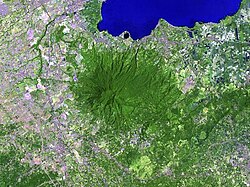
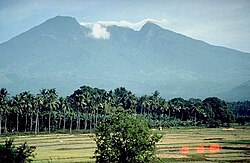
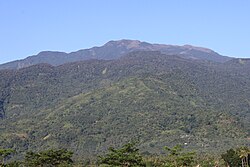
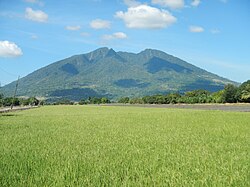
Los Baños is nestled between two of Southern Luzon's most dominant geographical features – Mount Makiling to the south and south-west and Laguna de Bay to the north. In fact, Laguna de Bay's southernmost tip is at Barangay Bambang, and Barangay Bagong Silang is already halfway up Mount Makiling. Both the mountain and the lake are volcanic features – Makiling being a potentially active volcano whose geothermal activities gave birth to the hot springs after which the town was named, and Laguna de Bay being the filled-in caldera of a massive prehistoric volcano.
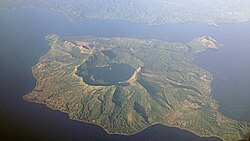
Another notable geological feature is Tadlac Lake, a maar lake whose almost perfectly round shape and uncharted waters have led some locals to call it "the enchanted lake". Others call it "alligator lake", a reminder that it served as the last bastion of Laguna de Bay's once-plentiful crocodile population, which has since been wiped out and is now just another legendary part of Philippine history.
It has a total land area of 56.5 square kilometers (21.8 sq mi) and is bordered on the south and south-west by Mount Makiling and Santo Tomas in Batangas, on the north by Laguna de Bay, on the north-west by Calamba and on the east by the town of Bay. The town is located 63 kilometers (39 mi) southeast of Manila and is easily accessible via the South Luzon Expressway along with Manila South Road and Calamba–Pagsanjan Road.
The municipality lies on the northern slopes of the long dormant volcano Mount Makiling and is known among tourists for its hot spring resorts.
Rivers
The town of Los Baños is crossed by five rivers or creeks:
The Dampalit river, which is named after an edible herb, dampalit (Sesuvium portulacastrum), which often grows near river shores, originates on the north face of Mt.
Demographics
In the 2024 census, the population of Los Baños was 117,030 people, with a density of 2,200 inhabitants per square kilometer or 5,700 inhabitants per square mile.
Government
Local government
Like other LGUs in the Philippines (perhaps with the exception of the BARMM), the town holds election every three years, which will cover from Mayor, Vice Mayor, and up to the councilors.
Economy
Poverty incidence of Los Baños (%)
Source: Philippine Statistics Authority
Tourism
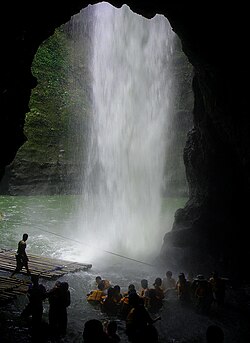
Los Baños's hot spring resorts (along with those in the preceding city of Calamba starting at Barangay Pansol) are frequent weekend or summer getaways for residents of the vast metropolis and tourists from primarily the National Capital Region (Metro Manila area) due to the town's proximity to Metro Manila and other places in the Philippines, and abroad. The town is also home to several native delicacies stores like the town's famous buko pie (coconut meat pie) as well as a home-grown brand of chocolate cake. It was also Laguna's richest municipality in terms of assets amounting to ₱652.95 million in 2017.
University of the Philippines Los Baños and other places of interest within its administered area
Mount Makiling
Makiling Botanic Gardens
ASEAN Center for Biodiversity
UPLB Museum of Natural History
Flatrocks – creek usually frequented by hikers
Mudspring – Presumed volcanic crater of Mt. Makiling
Peak 2 – Highest peak of Mt. Makiling
Pook ni Maria Makiling, an eco-tourism site adjacent to the Jamboree Site, National Arts Center, and U.P. Los Baños
Boy Scouts of the Philippines and Jamboree Site – a campsite at the foot of Mount Makiling adjacent to U.P. Los Baños, which is being managed by the Boy Scouts of the Philippines and the site of the 10th World Scout Jamboree in 1959, the 1st and 12th Asia Pacific Jamboree in 1973 and 1991, and the 1st ASEAN Jamboree in 1993.
National Arts Center – a patch of land at the foot of Mount Makiling adjacent to U.P. Los Baños, which is being managed by the Cultural Center of the Philippines and the site of the Philippine High School for the Arts, a special school for young artist scholars.
International Rice Research Institute
Philippine Rice Research Institute
Dairy Training & Research Institute
Education
The Los Baños Schools District Office governs all educational institutions within the municipality. It oversees the management and operations of all private and public, from primary to secondary schools.
There are 16 daycare schools in Los Baños, managed by DSWD and local government.
Higher educational institutions
Los Baños also hosts two constituent universities of the University of the Philippines System: the University of the Philippines Los Baños and University of the Philippines Open University, along with other foreign and local and international research centers, such as the International Rice Research Institute, the ASEAN Center for Biodiversity, the Philippine Rice Research Institute, Philippine Carabao Center, and the Southeast Asian Ministers of Education Organization-Southeast Asian Regional Center for Graduate Study and Research in Agriculture(SEAMEO-SEARCA) at UPLB making the town a temporary home for tens of thousands of both local and foreign undergraduate and graduate students, researchers and support staff.
Notable people
Paciano Rizal – military general and revolutionary; older brother of José Rizal
Rizalina Ilagan – anti-martial law activist that was abducted by state security agents and disappeared with nine other activists in what is believed to be the single biggest case of involuntary disappearance during Ferdinand Marcos' martial law in the Philippines that later came to be known as the Southern Tagalog 10.
Tony Mabesa – National Artist of the Philippines for Theater.
Ricardo Lantican – National Scientist of the Philippines for Plant Breeding
Bienvenido O. Juliano – National Scientist of the Philippines for Biochemistry
Aloysius Baes – environmental chemist, environmental and pro-democracy activist, educator, and musician.
Rogel Mari Sese – Filipino astrophysicist who is known for being a proponent of space science in the Philippines.
Jonas Baes – composer
Bonifacio Ilagan – writer, filmmaker, journalist, and activist.
Caesar Perez – 12th Vice Governor of Laguna and former Los Baños Mayor
Cielito Habito – economist, professor, and former NEDA Director-General
Emerlinda R. Roman – educator, university administrator, and 19th President of the University of the Philippines
Benjamin Madrigal Jr. – 51st Chief of Staff of the Armed Forces of the Philippines
Bryan Gahol – former Filipino professional basketball player in the Philippine Basketball Association.
Sister cities
Davis, California, United States
以上摘自英文维基百科「Los Baños, Laguna」(有删节;去掉了表格、图片、参考文献和外部链接),按 CC BY-SA 4.0 使用。全文和最新版本请看原文。