舆图
圣巴勃罗 城镇
San Pablo · 卡拉巴松
- 国家 / 地区
- 菲律宾
- 一级行政区
- 卡拉巴松
- 坐标
- 北纬 14.07°,东经 121.33°

示意图,边界据 Natural Earth,不作为划界依据。
更多资料
- 人口(Wikidata)
- 300,166(2024 年)
- 面积
- 197.6 平方千米
- 海拔(Wikidata)
- 237 米
- 所属行政区
- 内湖省
- 邮政编码
- 4000
- 电话区号
- 49
- 邻接
- Calauan、多洛雷斯
- 得名自
- 底比斯的保罗
- 友好城市
- 柏林布鲁克、圣马特奥、马卡蒂、河南市
人口变化
| 年份 | 人口 | 较上一次 | |
|---|---|---|---|
| 1903 | 22,612 | ||
| 1918 | 31,399 | +38.9% | |
| 1939 | 46,311 | +47.5% | |
| 1948 | 50,435 | +8.9% | |
| 1960 | 70,680 | +40.1% | |
| 1970 | 105,517 | +49.3% | |
| 1975 | 116,607 | +10.5% | |
| 1980 | 131,655 | +12.9% | |
| 1990 | 161,630 | +22.8% | |
| 1995 | 183,757 | +13.7% | |
| 2000 | 207,927 | +13.2% | |
| 2007 | 237,259 | +14.1% | |
| 2010 | 248,890 | +4.9% | |
| 2015 | 266,068 | +6.9% | |
| 2020 | 285,348 | +7.2% | |
| 2024 | 300,166 | +5.2% |
Wikidata 记录的历次人口数(普查和估计混在一起,口径可能不同)。
百科(英文)
这个词条没有中文维基百科条目,下面是英文维基百科的原文。
San Pablo, officially the City of San Pablo (Filipino: Lungsod ng San Pablo), is a component city in the province of Laguna, Philippines. According to the 2024 census, it has a population of 300,166 people.
The city is also known as the "City of Seven Lakes" (Filipino: Lungsod ng Pitong Lawa), referring to the Seven Lakes of San Pablo: Lake Sampaloc (or Sampalok), Lake Palakpakin, Lake Bunot, Lakes Pandin and Yambo, Lake Muhikap, and Lake Calibato.
San Pablo was part of the Roman Catholic Archdiocese of Lipa beginning in 1910. On November 28, 1967, it became an independent diocese and became the Roman Catholic Diocese of San Pablo.
Etymology
San Pablo derives its name from the Spanish for Saint Paul, referring to the local patron saint, Paul the First Hermit. It was previously known as San Pablo de los Montes, which translates to "Saint Paul of the Mountains" in Spanish.
History
San Pablo's earliest historical record dates back to pre-Spanish times when four large barrios bounded by Mount Makiling composed of settlements, the most prominent of which was "Sampalok" (Sampaloc). In 1571, the first Spanish troops under Captain Juan de Salcedo arrived in the upland village of Sampaloc. It was noted by Father Joaquin Martinez de Zuñiga that its original inhabitants were Aetas and were ruled by four chieftains.
San Pablo became a parish in 1586, and then a municipality in 1647, and was renamed "San Pablo de los Montes" in honor of Saint Paul the First Hermit.
Augustinian friar, Father Hernando Cabrera built the first church made of wood. It was noted that the sacristy of this church was ornamented and contained silver, which rivalled and even surpassed that of Spain.
In 1756, it was placed under the jurisdiction of Batangas province but was returned to Laguna in 1883. The 1818 Spanish census recorded there to be 1,948 native families living in harmony with 7 Spanish-Filipino families.
In 1899, a municipal government was established, with Atty. Innocente Martinez as municipal president. Marcos Paulino was elected municipal president in 1902 when the civil government was set up.
Geography
San Pablo is located in the southern portion of Laguna province, 82 kilometers (51 mi) southeast of Manila via Alaminos and 37 kilometers (23 mi) southwest of Santa Cruz via Calauan.
By land area, it is the largest in Laguna province; by population, it is the sixth largest, after the cities of Calamba, Santa Rosa, Biñan, San Pedro, and Cabuyao.
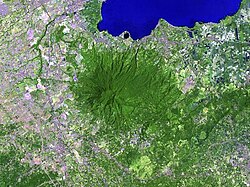
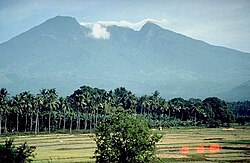
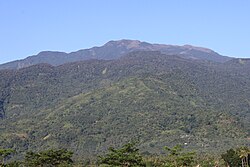
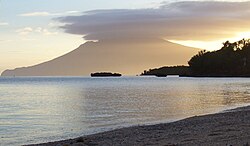
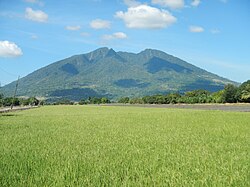
San Pablo has a cool climate owing to its location. It is located in the foothills of three mountains: Mount Banahaw, Mount Makiling and the Sierra Madre Mountains within the Laguna Volcanic Field, also known as the San Pablo Volcanic Field.
The climate and soil are suitable for agriculture. The different barangays have plantations for coconuts, lanzones fruit (Lansium parasiticum), and rambutan fruit.
Climate
The prevailing climatic conditions in the city is categorized into wet and dry seasons.
Barangays
San Pablo is politically subdivided into 80 barangays, as indicated below. Each barangay consists of puroks and some have sitios.
Demographics
According to the 2024 census, San Pablo had a population of 300,166 people, up from 266,068 people in the 2015 census. The city was once the largest city in Laguna, but it was overtaken by Calamba in the 1990 census. San Pedro followed suit in 1995, then came Santa Rosa and Biñan in 2007, and Cabuyao in 2015, all owing their growth to its proximity to Metro Manila.
Ethnicity and language
The language spoken in the city and the medium of instruction in schools are English and Filipino, also known as Tagalog in this area.
Economy
At the end of the 20th century and the start of the 21st century, economic development shifted from San Pablo to western Laguna. San Pedro, Biñan, Santa Rosa, Cabuyao, Calamba, Los Baños, and Santa Cruz experienced rapid economic development brought about by local and foreign investments, the rapid growth of industrial estates and export processing zones, and the placement of major institutions in those areas, San Pablo City was left behind and remained a semi-developed residential community.
Despite the fact that the city was partly touched by economic development, San Pablo boasts itself as a potential eco-tourism destination in the province. However, given its human and land resources, various BPO companies are seriously looking at developing the city into the ICT hub of Southern Luzon. Although there were previous attempts to build a similar establishment, SM Prime Holdings was given its go signal in July 2008 to push ahead for SM City San Pablo located at Riverina Commercial Estates along Maharlika Highway at Barangay San Rafael.
Tourism and recreation
Natural Attractions
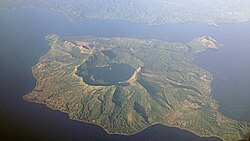
The Seven Lakes of San Pablo, seven crater lakes scattered around the city, have for many generations provided food and livelihood, leisure and respite for the citizens of the city. A bustling city of trade and commerce, it is also a center of education and learning with schools, colleges, and training institutions.
Lake Sampaloc, located behind the City Hall, is the youngest crater lake in the San Pablo volcanic field and the largest of the Seven Lakes of San Pablo.
Lake Bunot
Lake Calibato
Twin Lakes – Lakes Pandin and Yambo
Lake Palakpakin
Lake Muhikap
Built attractions
Hacienda Escudero Plantation Resort Town is the largest planned community investment in the city covering 415 hectares (1,030 acres). The resort has the richness of coconut plantation, and provides serenading Filipino songs and Bayanihan Dances (Folk Dances).
Public Playground at Sampalok Lake (Katuparan ng Pangarap: Fulfillment of Dreams) is a public playground in the city built during the term of mayor Atty. Zacarias Africa Ticzon, who as well improved tourism places around Lake Sampaloc, that is near the municipal City Hall. Both places serve as haven for sports, and recreation. The vicinity for tourism consequently encouraged small businesses for restaurants of native dishes catering visitors of the area.
Government
Elected officials
Due to the six-month suspensions of Mayor Arcadio Gapangada Jr. and Vice Mayor Justin Colago beginning in July 2026 following lawsuits filed against each other, Carmela Acebedo and Shaira Aliyah Diaz assumed the roles of acting mayor and acting vice mayor, respectively.
Infrastructure
Healthcare
Most of the large hospitals in San Pablo are located in the city proper, but there are also health centers built for each barangay in San Pablo.
Notable hospitals and medical centers are as follows:
Community General Hospital of San Pablo City
San Pablo Colleges Medical Center
San Pablo City Doctors' Hospital
San Pablo City General Hospital
San Pablo City District Hospital
Sts Francis and Paul General Hospital
Transportation
San Pablo city is along the Maharlika Highway which leads to Quezon province. Jeepneys connect San Pablo city proper with nearby Calauan and Rizal, as well as other cities like Tanauan, Santo Tomas, and Calamba. It is also served by vans heading to the cities of Lipa, Santa Rosa, and Biñan.
Philippine National Railways has a station for its southern main line near the city proper.
The San Pablo City Central Terminal, opened in 2023, is the city's main bus terminal that serves commuters going to Metro Manila, as well as other provincial destinations.
Utilities
San Pablo's water source is run by its own San Pablo City Water District and is assisted by NAWASA. San Pablo's electricity is run by Meralco.
Telecommunications
Citizens of San Pablo mainly use PLDT (including Smart), Globe, and Dito Telecommunity, although some may use other internet service providers.
Notable personalities
Politics
Vicente Belen Amante, former city mayor
Sol Aragones, former journalist, 3rd District Representative and Governor of Laguna
Cynthia Barker, English politician and former mayor of Hertsmere, England
Alexander Gesmundo, 27th Chief Justice of the Supreme Court of the Philippines
Arturo Brion, 161st Associate Justice of the Supreme Court
Liza Maza, activist, former Gabriela Partylist and Bayan Muna Partylist Representative
Victor Corpus – military officer and public official
Angelica Jones, Actress-comedianne, 3rd district board member of Laguna
Orlan Calayag, Former mayor of Dolores, Quezon Province, Former administrator of the National Food Authority (NFA)
Business
Jaime Aristotle Alip, Businessman, Founder of CARD Mutually Reinforcing Institutions
Antonio C. Delgado, industrialist and civic leader, Philippine ambassador to the Vatican
Entertainment, Journalism, Literature & Arts
Patis Tesoro – National Artist of the Philippines for Fashion Design
Bayani Casimiro Sr., bodabil performer dubbed the "Fred Astaire of the Philippines"
Celso Al. Carunungan, writer, novelist, and film scriptwriter
HaveYouSeenThisGirL, author-novelist of Diary ng Panget
Gerry Alanguilan, a.k.a. "Komikero," comic book artist and writer best known for his graphic novels Wasted and Elmer
Edgar Calabia Samar, poet and fictionist
以上摘自英文维基百科「San Pablo, Laguna」(有删节;去掉了表格、图片、参考文献和外部链接),按 CC BY-SA 4.0 使用。全文和最新版本请看原文。