舆图
坎德拉里亚 城镇
Candelaria · 卡拉巴松
- 国家 / 地区
- 菲律宾
- 一级行政区
- 卡拉巴松
- 坐标
- 北纬 13.93°,东经 121.42°

示意图,边界据 Natural Earth,不作为划界依据。
更多资料
- 人口(Wikidata)
- 137,933(2024 年)
- 面积
- 129.1 平方千米
- 海拔(Wikidata)
- 91 米
- 所属行政区
- 奎松省
- 设立
- 1879 年
- 邮政编码
- 4323
- 电话区号
- 42
- 邻接
- 多洛雷斯、萨里阿亚、地亚望、泰巴巴斯
人口变化
| 年份 | 人口 | 较上一次 | |
|---|---|---|---|
| 1918 | 8,210 | ||
| 1939 | 17,686 | +115.4% | |
| 1948 | 21,116 | +19.4% | |
| 1960 | 29,928 | +41.7% | |
| 1970 | 44,031 | +47.1% | |
| 1975 | 49,384 | +12.2% | |
| 1980 | 54,629 | +10.6% | |
| 1990 | 69,969 | +28.1% | |
| 1995 | 80,733 | +15.4% | |
| 2000 | 92,429 | +14.5% | |
| 2007 | 105,997 | +14.7% | |
| 2010 | 110,570 | +4.3% | |
| 2015 | 117,434 | +6.2% | |
| 2020 | 137,881 | +17.4% | |
| 2024 | 137,933 | +0.0% |
Wikidata 记录的历次人口数(普查和估计混在一起,口径可能不同)。
百科(英文)
这个词条没有中文维基百科条目,下面是英文维基百科的原文。
Candelaria, officially the Municipality of Candelaria (Tagalog: Bayan ng Candelaria), is a municipality in the province of Quezon, Philippines. According to the 2024 census, it has a population of 137,933 people.
It is the third most populous settlement of Quezon after Lucena and Sariaya. Among the municipalities in Quezon Province, Candelaria has the most desiccated coconut factories and oil refineries, such as Peter Paul Philippine Corporation, Primex Coco Products Inc., Pacific Royal Basic Foods, SuperStar Corporation, Tongsan Industrial Development Corporation, and others, which employ thousands of people.
History
Foundation
Prior to 1885, the pioneering barangays of Candelaria in its western part, Taguan (Bukal), Kinatihan and Masin were parts of the Municipality of Tiaong, while Malabanban, Mangilag and Santa Catalina in the east, were under the jurisdiction of the town of Sariaya. Don Ciriaco Nadres, a local leader of Barangay Masin and his wife Sra. Doña Baltazara Bustamante, with the support of Don Simeon Nadres and wife Doña Everista Ona, Don Justo Argao, Don Elino de Gala, Don Apolinario Gonzales, Don Tomas Cabuñag, Don Ignacio de Ramos, Don Domingo de Alday, Don Tomas Regidor, Don Juan del Valle, Don Ambrocio Salazar, Don Buenaventura Cedeño and Don Hipolito Martinez, proposed the establishment of an independent government over these barangays. They became known as the founding families of the town.
It was on December 26, 1878, that a permit was granted by the Governor-General of the Philippine Islands, Domingo Moriones y Murillo for the establishment of an independent government over these barangays. Its boundaries were fixed by means of a treaty signed by the notable leaders of Tiaong, Sariaya and the founding families of Candelaria.
Geography
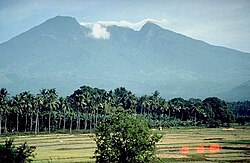
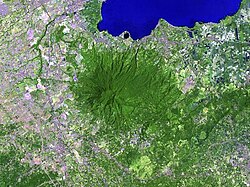
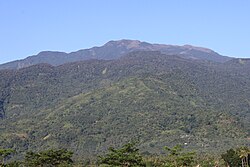
Candelaria lies at the western part of the province, 108 kilometres (67 mi) from the nation's capital Manila, 22 kilometres (14 mi) from the provincial capital Lucena, and 61 kilometres (38 mi) from Batangas City. To its northern part lies the famous Mount Banahaw, to the east is Sariaya, to the south is San Juan, and to the west are Dolores and Tiaong. The neighboring cities are Lucena, Tayabas, San Pablo and Lipa. It is traversed by the Pan Philippine Highway and the Philippine National Railways.
Candelaria has an area of about 12,910 hectares (31,900 acres) and is an agricultural municipality, situated in the southern part of Mount Banahaw. The town proper is wedged by two rivers, namely, Masin and Quiapo rivers.
Barangays
Candelaria is politically subdivided into 25 barangays, as indicated in the matrix below. Each barangay consists of puroks and some have sitios.
Climate
There are two pronounced seasons in Candelaria: Dry and hot season from March to May, Wet season from June to December. Typhoons struck the municipality every three to five years.
Demographics
Candelaria has a population of 137,933 as of the 2024 census. The increase in population became rapid in the 1990s due to a major economic boom, in 1995, it has a population of 80,733 inhabitants, while in 2000, the population grew to 92,429, with an increase of about 15 percent.
In 2007, the official number of inhabitants in the municipality based on 2007 census is 105,997, or about 4,240 families or 21,243 households. Most Candelariahins reside in Pahinga Norte and Malabanban Norte, the adjacent barangays of the town proper.
As of 2007, almost 93 percent of the population are mostly Roman Catholics, 3.5 percent are Protestants, about 3 percent are members of Iglesia ni Cristo, 0.05 percent are of Islam, 0.97 percent are of other denominations such as Church of Christ/Christian Churches, Pentecostals, Baptists, Latter Day Saints, Seventh-day Adventist, Jehovah's Witnesses and others.
Language
Tagalog is widely spoken by the populace. However, their accent resembles the Tagalog dialect spoken in Batangas owing to its location, and history. Most of the residents came from the neighboring province of Batangas.
Economy
Poverty incidence of Candelaria (%)
Source: Philippine Statistics Authority
Candelaria is one of the most progressive municipalities in Quezon Province. Rapid progress have been felt since the 1990s where most of the commercial establishments have been built such as retail merchandising, supermarkets, hardware, fastfood outlets or restaurants, shopping mall, and others. The Candelaria Public Market, though it is adjacent to Barangay Poblacion, is located on Barangay Pahinga Norte.
In 2024, there is a total inventory of 812 registered establishments. Most are in retail trade, wholesale, and real estate leasing.
In agriculture, coconut is the most dominant crop of the municipality covering 5,243.50 hectares or 30% of the town's land area. In terms of livestock production, many locals raised poultry by 73.30% from the overall animal population.
Culture
Candle Festival
The town fiesta is celebrated on February 5 to honor the patron saint of Candelaria, San Pedro Bautista. Since 2017, Rev. Msgr. Melecio Verastigue, started a dance to honor San Pedro Bautista, which is now known as Indak Pugay.
Since 2005, Msgr. Carlos "Charles" Pedro A. Herrera, the parish priest of the San Pedro Bautista Parish, started his devotion to Nuestra Senora de Candelaria and honored her with a Candle Festival every February 2. The celebration was concluded with a procession through the streets of the town featuring the street dancing by the youth of the community in honor of the Blessed Virgin. A parade of floats representing each of the 25 barangays was, also, featured during the festivities.
A project in honor of the Blessed Mother Mary that will renovate the patio of the San Pedro Bautista Parish Church had been developed on April 22, 2012. The renovated patio will convert the current parking lot into a multi-purpose open amphitheater for use of the people of Candelaria.
Government
Elected officials
Municipal council (2025-2028):
Mayor: George D. Suayan
Vice Mayor: Ireneo C. Boongaling
Councilors:
Davielyn A. Alcala
Aileen M. Dellosa
Estelito A. Sulit
Joy Anne M. Pasumbal
Numeriano S. Briones
Anatalia R. Atienza
Manuel Antonio V. De Luna
Ma. Lourdes Bernadette G. Liwanag
ABC President: Manuel S. Ebora
SK Federation President: Ann Ivy Nicole B. Cuadro
Infrastructure
Transportation
Road network
Three major highways pass through the municipality and the town proper. The South Luzon Expressway Toll Road 4 (TR4) stretching from Santo Tomas, Batangas to Lucena will pass through the northern part of the municipality, planned to be finished in 2028. The new expressway will occupy portions of Barangays Bukal Norte, Masalukot II, Masalukot I, Mayabobo, and Mangilag Norte.
The Pan-Philippine Highway (also known as Maharlika Highway or National Highway), passes through the municipality west–east from Barangay Bukal Sur to Barangay Mangilag Sur. It connects the municipality to its neighboring towns of Tiaong and Sariaya and cities like San Pablo in Laguna and Lucena, the provincial capital.
Rizal Street is the two-lane main road and a segment of the Pan-Philippine Highway in Barangay Poblacion. It connects Barangay Masin Norte and Sur in the west and Malabanban Norte in the east. Some landmarks located here are the Municipal Hall, the Catholic Church, and Plaza Narra.
Water transport
Candelaria has no coastline and is one of the inland municipalities of Quezon, together with Dolores, Lucban, Sampaloc, San Antonio, Tayabas, and Tiaong.
Healthcare
Candelaria has three hospitals: one public and two private.
Candelaria Municipal Hospital (known as Nursery, built in 1984) - located in Barangay Masin Norte, near the barangay hall of masin norte.
Peter Paul Medical Center (formerly Peter Paul Hospital, built in 1948) - located in Regidor St., Barangay Poblacion.
United Candelaria Doctors Hospital (built in 2007) - located in Maharlika Highway near Candelaria Bypass Road, Barangay Mangilag Sur.
The Candelaria Municipal Hospital is built during the administration of then Mayor Pedro Cedeno in 1984. Peter Paul Medical Center is one of the pioneering hospitals of the municipality, established in 1948. United Candelaria Doctors Hospital is the newly built medical facility of Candelaria, opened in February 2009.
Each barangay has its own health center for free health services. More lying-in clinics are located throughout the municipality.
Education
There are two schools district offices which govern all educational institutions within the municipality. They oversee the management and operations of all private and public, from primary to secondary schools. These are the Candelaria East Schools District Office, and Candelaria West Schools District Office.
Notable personalities
Raimund Marasigan, rock musician of the band Eraserheads, Pedicab, Sandwich, Cambio, Project 1, Squid 9, and Gaijin
Ahtisa Manalo, Miss Universe Philippines 2025 and Miss International 2018 1st Runner-Up
Rio Locsin, actress
Cirilo Rigos, Member of the 1986 Constitutional Commission and pastor
以上摘自英文维基百科「Candelaria, Quezon」(有删节;去掉了表格、图片、参考文献和外部链接),按 CC BY-SA 4.0 使用。全文和最新版本请看原文。