舆图
泰巴巴斯 城镇
Tayabas · 卡拉巴松
- 国家 / 地区
- 菲律宾
- 一级行政区
- 卡拉巴松
- 坐标
- 北纬 14.03°,东经 121.59°

示意图,边界据 Natural Earth,不作为划界依据。
更多资料
- 人口(Wikidata)
- 115,318(2024 年)
- 面积
- 230.9 平方千米
- 海拔(Wikidata)
- 228 米
- 所属行政区
- 奎松省
- 邮政编码
- 4327
- 电话区号
- 42
- 邻接
- 卢塞纳、阿蒂莫南、Pagbilao、毛班、萨里阿亚、坎德拉里亚、卢克班
人口变化
| 年份 | 人口 | 较上一次 | |
|---|---|---|---|
| 1903 | 14,740 | ||
| 1918 | 14,983 | +1.6% | |
| 1939 | 18,172 | +21.3% | |
| 1948 | 16,989 | -6.5% | |
| 1960 | 25,758 | +51.6% | |
| 1970 | 35,166 | +36.5% | |
| 1975 | 37,756 | +7.4% | |
| 1980 | 42,137 | +11.6% | |
| 1990 | 54,355 | +29.0% | |
| 1995 | 64,449 | +18.6% | |
| 2000 | 70,985 | +10.1% | |
| 2007 | 87,252 | +22.9% | |
| 2010 | 91,428 | +4.8% | |
| 2015 | 99,779 | +9.1% | |
| 2020 | 112,658 | +12.9% | |
| 2024 | 115,318 | +2.4% |
Wikidata 记录的历次人口数(普查和估计混在一起,口径可能不同)。
百科(英文)
这个词条没有中文维基百科条目,下面是英文维基百科的原文。
Tayabas, officially the City of Tayabas (Filipino: Lungsod ng Tayabas), is a component city in the province of Quezon, Philippines. According to the 2024 census, it has a population of 115,318 people.
The city is known for various historical landmarks like ancestral houses, more than twenty Spanish colonial stone bridges, 16th century stone crosses believed to be abodes of nature spirits, festivals, and local delicacies like lambanog and various desserts, alongside resorts and rest and recreation facilities. It was the former capital of Quezon (then named Tayabas). The prevalent architectural sites of the city, including its bridges, has led numerous scholars to campaign its inclusion in the UNESCO World Heritage List.
Etymology
Sociologist Rolando V. Redor advanced that the name Tayabas was suggested because of the abundance of ferns called ''tagabas''.
According to one reference, Tayabas
''tayaban''. Tayaban is a night creature known for having wings that glow like tropical fireflies.
From the dialect of Tayabas Tagalog, there is also the word ''tayaba'', which is an indigenous practice of the igba for planting.
One of the popular theories for the origin of the name Tayabas is that it comes from the word ''bayabas'' (guava), but the said fruit is not native to the Philippines.
History
Early history
Tayabas is at the center of the province's long-settled heartland, which possessed the best lands, the oldest parishes, and the most active commercial centers. The provincial heartland was later described by Manuel L. Quezon as having the "richest and gayest places in the province."
In 1578, Fray Juan de Plasencia and Fray Diego de Oropesa, two Franciscan missionaries from Spain founded the town of Tayabas in order to spread Christianity to its natives. Prior to the occupation, however, the native Tayabenses lived in rural settlements (barangay) typical of those times, headed by chiefs and a council of elders. During this time, ancestral stones and rocks that the people believed to be abodes of nature spirits were turned to stone crosses due to the influx of Christianity. They exist up to this day, however, many have been stolen, uprooted, sold and destroyed due to the belief of foreign treasure hunters that each cross contains treasures.
Historians and archaeologists have disproved these claims by treasure hunters and have found no treasure in any archaic stone crosses in Tayabas. The destruction and uprooting of these crosses has "endangered the stone cross tradition of Tayabas." By the end of the 1700s, Tayabas had 7,396 native families and 12 Spanish Filipino families.
From 1605 to 1901, Tayabas was the capital of the Province of Tayabas, now known as Quezon. In the 19th century, Tayabas was among the biggest towns in the country. Its Minor Basilica of St. Michael the Archangel, which was enlarged in the mid-1850s, is the longest church in the country and is a testament to its past.
In more than three centuries of Spanish occupation, only eight cities and towns were given the title of Villa, and Tayabas was one of them. These are La Villa del Santisimo Nombre de Jesus de Cebu in 1565, La Villa de Santiago de Libon (Albay, 1573), La Villa Fernandina de Vigan (Ilocos, 1574), La Villa Rica de Arevalo (Iloilo, 1581), La Noble Villa de Pila (Laguna, 1610), La Muy Noble Villa de Tayabas (Tayabas, 1703), La Villa de Bacolor (Pampanga, 1765), La Villa de Lipa (Batangas, 1887).
Geography
Tayabas is 9 kilometers (5.6 mi) from Lucena and 139 kilometers (86 mi) from Manila and it is accessible by land from Metro Manila passing through Rizal and Laguna east via Manila East Road or via South Luzon Expressway.
Barangays
Tayabas is politically subdivided into 66 barangays, as indicated below. Each barangay consists of puroks and some have sitios.
Economy
Poverty incidence of Tayabas (%)
Source: Philippine Statistics Authority
The major agricultural products of Tayabas are rice and coconut. It is also known for sweet delicacies, budin (cassava cake) and lambanog.
Notable Places of Interest
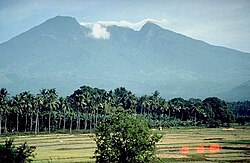
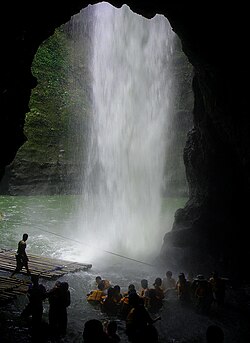
Tayabas is rich in history as it was the capital of Tayabas Province (Now in Quezon) during Spanish era. There are falls, caves, river, and hills/mountains to discover.
Minor Basilica of St. Michael the Archangel
The Minor Basilica of St. Michael the Archangel is a Roman Catholic basilica located in Tayabas, Quezon. It is the largest Catholic church in the Province of Quezon. It is renowned for having the shape of a key. Locals often refer to the church as Susi ng Tayabas. On October 18, 1988, the title Minor Basilica was conferred by Pope John Paul II. It was proclaimed on January 21, 1989.
Casa Comunidad de Tayabas
Constructed in 1831 when Don Diego Enriquez was gobernadorcillo, it is primarily designed as a guesthouse for visiting Spanish dignitaries. According to Buzeta and Brazo, Tayabas in 1851 had a Casa de Comunidad where the prison was located. The Tribunal seems to have been located in the Casa as well. In 1887, Juan Alvarez Guerra, a Spanish official, says that "beyond dispute, it is one of the best in the Philippines... It has spacious halls, magnificent decor, and ornate furniture". He adds that at one corner of the Tribunal was the telegraph station. Unfortunately, shortly after his book was written, a horrific fire consumed the building as well as others in the city. Alfred Marache locates the fire at around 1882–1883. During the American period, the reconstructed building became a public school. Thus from being the center of the local judicial system, it became the center of the community's intellectual life. It was destroyed once more in the bombing of 1945. In the 2000s, Casa de Comunidad was reconstructed by the National Historical Institute. Casa de Comunidad is a national historical landmark which houses the local museum and the municipal library. It is host to many cultural and historical activities. This century old building, is the place where Apolinario "Hermano Pule" Dela Cruz was tried and sentenced to death in 1841.
Malagonlong Bridge
Culture
Festival
Mayohan sa Tayabas
Tayabas is also known for the annual Mayohan sa Tayabas (San Isidro Festival), celebrated every month of May. This is a harvest festival honoring San Isidro Labrador, the patron saint of farmers. The festival is a significant event for the people of Tayabas, as it showcases their rich cultural heritage, promotes tourism in the area, and pays homage to the local farmers who have been the lifeblood of Tayabas' economy for generations.
This festival usually opens at the beginning of the month with a Parada ng Baliskog. Baliskog, the local term for welcome arch, is usually made of indigenous materials such as coco leaf, coco husk, bamboo poles, buli, rattan, dried flowers, tistis and other decors such as local flowers, corn, and palay. The parade also includes tao-tao, a local term for scarecrows used by farmers on their farms. A Parada ng Tagay is also included in the welcoming parade to promote Lambanog, the proudest product of the town. This parade is participated by some members of different barangays and also by various organizations and barangay associations.
The main highlight of this festivity is the procession of the image of San Isidro Labrador, which is held every May 15. It passes through the town center, where houses are decorated with pabitin, kiping, crops, and other indigenous materials. Men accompanying the procession will participate in Hagisan ng Suman, in which massive amounts of suman will be thrown at the crowd. Suman is considered a ritual gift by the Tayabasin people. It is believed that it will bring prosperity and luck. An estimate of at least 12,000 pieces of suman are thrown every Mayohan Festival. The pabitin, which are tied with suman and other summer fruits like banana, pineapple, buko, and mango, will be emptied as soon as the image of San Isidro Labrador passes by.
Transportation
Jeepneys and tricycles are common options when travelling to destinations within the downtown and the city.
To ease the traffic situation in Tayabas, the San Miguel Corporation will build a 66.74 km extension of South Luzon Expressway, also known as SLEX-TR4.
Notable personalities.
Bishop Alfredo Maria Obviar – first bishop of the Diocese of Lucena, founder of MCST, declared a Venerable
Hermana Fausta Labrador – born in Tayabas/founder of Sacred Heart College (Lucena City). her father's surname was originally San Agustin until he changed it to Labrador in compliance with the decree of Governor General Narciso Claveria
Paraluman (Sigrid Sophia Agatha von Giese y de Torres) – December 4, 1923 – April 27, 2009 – Award-winning actress active from the 1940s to the 1970s
Tommy Abuel – a multi-awarded actor in the Philippines.
Heidi Mendoza – former Under-Secretary-General of the United Nations Office of Internal Oversight Services (OIOS) from 2015 to 2019 and Commissioner of the Commission on Audit (COA) from 2011 to 2015.
Sister cities
Lucena, Philippines
Makati, Philippines
Palayan, Philippines
以上摘自英文维基百科「Tayabas」(有删节;去掉了表格、图片、参考文献和外部链接),按 CC BY-SA 4.0 使用。全文和最新版本请看原文。